
South Korean oil refiners have significantly increased their imports of American crude oil as the conflict in Iran has made it difficult to source oil from the Middle East. They have been actively seeking crude oil from various regions, including Libya and Nigeria in Africa, and even the Philippines.
Among Middle Eastern countries, imports from Qatar have plummeted by over 50%, while imports from Iraq and Kuwait have decreased by nearly 15%. As a result, the share of Middle Eastern crude oil imports has dropped to the 60% range.
U.S. Crude Oil Imports Surge 30% From January to April, Exceeding 20% of Total Imports
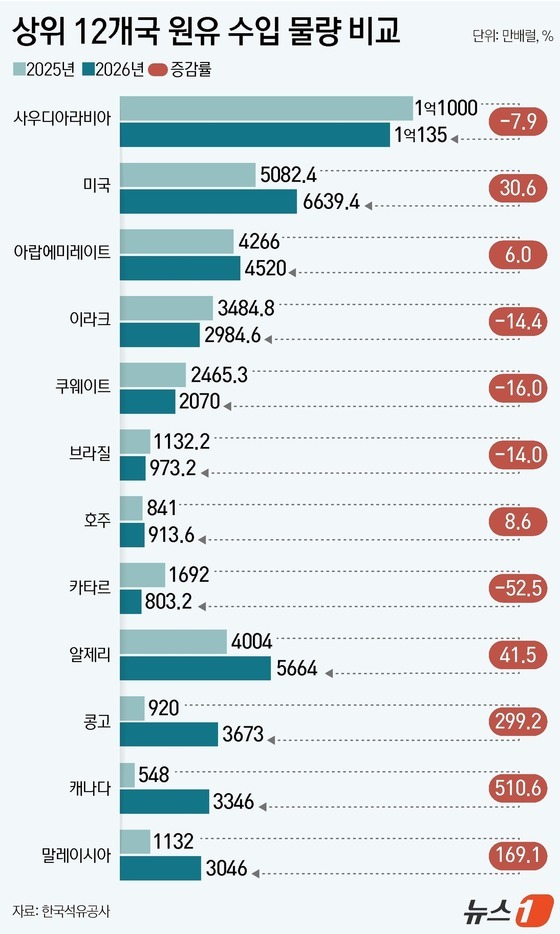
According to the Korea National Oil Corporation, South Korea imported 66.39 million barrels of U.S. crude oil from January to April this year, a 30.6% increase compared to the same period last year. The import value rose from 4.05 billion USD to 5.27 billion USD, a 30.1% increase. The share of U.S. crude oil in total imports climbed from 15.5% to 20.7%.
The total crude oil imports from January to April this year reached 320.71 million barrels, a 2.5% decrease from 328.77 million barrels during the same period last year.
The total import value fell from 25.81 billion USD last year to 24.62 billion USD this year, a decline of 4.6%.
Middle East Dependence Decreases as Imports From Saudi Arabia and Qatar Shrink
Unlike the U.S., the share of Middle Eastern oil, traditionally a key source of crude, has diminished.
Total imports from major Middle Eastern suppliers, including Saudi Arabia, the United Arab Emirates (UAE), Iraq, Kuwait, Qatar, and neutral zones, amounted to 207.82 million barrels, down 11.2% from 234.25 million barrels during the same period last year. The share of Middle Eastern crude oil in total imports decreased from 71.2% to 64.8%.
Saudi Arabia’s imports fell to 101.35 million barrels, a 7.9% decrease from 110 million barrels last year. While it maintained the top position with a 31.6% share, it couldn’t escape the downward trend. Imports of Qatari crude plummeted by 52.5% to 8.03 million barrels.
Iraq and Kuwait also reported decreases of 14.4% and 16.0%, respectively, with imports of 29.85 million barrels and 20.7 million barrels. The UAE was the only major oil-producing country to see an increase, recording a 6% rise to 45.2 million barrels.
Crude Oil Imports from Canada, Congo, and Malaysia Increase Year-Over-Year
Amid global supply chain restructuring, crude oil import price volatility has intensified. As of April this year, total crude oil imports reached 64.5 million barrels, a 21.6% decrease from the same month last year. However, the average price surged from 76 USD per barrel to 109 USD per barrel.
Facing uncertainties stemming from the Iran conflict, rising costs, and increased logistics expenses, South Korean refiners are continuing to diversify their import sources.
Imports of Canadian crude surged to 3.35 million barrels, a staggering 510.6% increase from 548,000 barrels last year. The import value jumped from 38.22 million USD to 309.95 million USD.
Imports of crude oil from Congo and Malaysia also saw significant increases of 299.2% and 169.1%, reaching 3.67 million barrels and 3.05 million barrels, respectively. New imports from the Philippines, Libya, and Nigeria, which were not part of the previous year’s import records, have now been added to the supply chain.
An industry insider stated that it’s crucial for refineries to maintain continuous operations. The uncertain situation makes it difficult to predict how long the crisis in the Middle East will last. While these new sources may not be ideally suited for our domestic facilities, they’re responding by sourcing crude oil from various regions outside the Middle East.