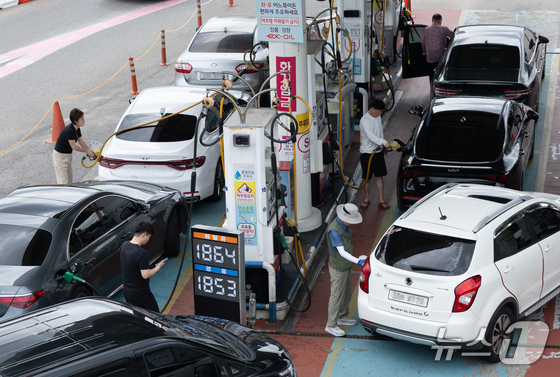
International oil prices, which had stabilized following the peace agreement between the U.S. and Iran, are once again surging after President Donald Trump announced the resumption of a maritime blockade against Iran. There are growing concerns that domestic fuel prices in the U.S., which recently dropped to around 1,800 KRW (about 1.21 USD) per liter, may soon rise again.
Industry analysts predict that if the increase in global oil prices affects the Singapore oil product price (MOPS), which serves as a benchmark for Asian petroleum products, U.S. gas station prices could also see an uptick by the end of this month.
Despite a recent decrease in oil prices due to eased tensions in the Middle East,
industry reports from Tuesday indicate that domestic fuel prices experienced significant fluctuations in the first half of this year, largely influenced by the volatile geopolitical situation in the region.
As military tensions between the U.S. and Iran escalated and fears of a blockade in the Strait of Hormuz grew, global oil prices surged, pushing domestic gasoline prices above 2,000 KRW (about 1.34 USD) per liter. Diesel prices also exceeded 2,000 KRW (about 1.34 USD) per liter for the first time in nearly four years, significantly increasing the financial burden on consumers.
After both countries agreed to a ceasefire and concerns about oil supply eased, global oil prices returned to pre-conflict levels, leading to a decline in domestic fuel prices.
According to the Korea National Oil Corporation’s oil price information service Opinet, as of 4:00 p.m. (Korean time) on June 24, the average selling price of diesel at gas stations nationwide was 1,999.97 KRW (about 1.34 USD) per liter, dropping below 2,000 KRW (about 1.34 USD) for the first time in about two months. At the same time, the average gasoline price was recorded at 2,007.3 KRW (about 1.34 USD) per liter.
This downward trend continued. As of yesterday afternoon, the average gasoline price at gas stations nationwide fell to 1,877.55 KRW (about 1.26 USD) per liter, while diesel prices dropped to 1,862.29 KRW (about 1.25 USD) per liter. Both fuel types, which had been above 1,900 KRW (about 1.27 USD) earlier this month, decreased to the 1,800 KRW (about 1.21 USD) range, with some regions even seeing gas stations offering prices in the 1,700 KRW (about 1.14 USD) range.
The Hormuz Risk Reignites… MOPS Becomes a Key Factor
However, the situation is changing rapidly. On Monday, President Trump announced the resumption of the maritime blockade against Iran, intensifying military pressure around the Strait of Hormuz. In response, Iran has maintained its hardline stance, leading to renewed tensions in the Middle East.
The Strait of Hormuz is a critical shipping route through which about 20% of the world’s oil maritime traffic passes. Any military conflict in this area raises concerns about oil supply disruptions, prompting an immediate reaction in global oil prices.
Following President Trump’s announcement, Brent and West Texas Intermediate (WTI) crude oil prices surged significantly during trading, reflecting heightened geopolitical risks. According to the Wall Street Journal, both prices jumped nearly 10%, marking the largest increase since 2020.
However, U.S. gas station prices are more influenced by MOPS than by global oil prices. MOPS serves as the benchmark price for gasoline and diesel products traded in Asia and is the basis for pricing set by domestic refiners.
Typically, when global oil prices rise, the prices of refined oil products also increase, leading to a subsequent rise in MOPS. This, in turn, affects the pricing set by domestic refiners and gas stations.
Changes in global oil prices or MOPS usually take 2 to 3 weeks to affect gas station prices. Therefore, if the current Middle Eastern tensions do not resolve quickly, fuel prices could face upward pressure again starting at the end of this month.
The key variable is the duration of the conflict between the U.S. and Iran. If it remains a short-term military clash, global oil prices might stabilize again. However, if disruptions to shipping in the Strait of Hormuz become a reality, both global oil prices and MOPS could rise together, pushing domestic fuel prices back up to the 1,900 KRW (about 1.27 USD) per liter range.
Park Sang-hyun, an analyst at iM Securities, noted that with the U.S. considering imposing a safety assurance toll on civilian vessels passing through the Strait of Hormuz, the market is viewing this as another factor contributing to rising prices, regardless of whether it is actually implemented. If such tolls materialize, they could drive up transportation costs and raw material prices, potentially fueling inflation.
The blockade is set to commence at 5:00 a.m. Korean time on Wednesday.