The rapid spread of artificial intelligence (AI) and the United States’ protectionist trade policies have dramatically reshaped South Korea’s manufacturing and trade landscape in just three years. Chinese automobiles have surged to the top of import rankings, overtaking Germany, while Taiwan has leaped from fourth to second place among South Korea’s semiconductor export destinations.
On Monday, the Bank of Korea released an updated version of its Key Manufacturing Production and Supply Chain Map of South Korea report. This comprehensive document details the production status by region, export and import structures of raw materials and intermediate goods, and the state of 11 major manufacturing sectors, including semiconductors and automobiles.
The Bank of Korea’s analysis reveals that since the initial report in 2023, factors such as the proliferation of generative AI, growth in Chinese manufacturing, intensified protectionism, and expanded environmental regulations have significantly altered the production and trade structures of domestic manufacturing.
The automotive and semiconductor industries, in particular, have experienced notable structural shifts in production and trade.
Chinese Automobiles Dethroned Germany as Top Import By Value, With Their Market Share Expanding Tenfold in Just Three Years
The presence of Chinese cars in South Korea’s import market has grown exponentially.
In 2022, Chinese cars accounted for a mere 3.5% of total automobile imports. By last year, this figure had skyrocketed to 37.2%. Projections for 2025 indicate that the share of Chinese imports will slightly surpass that of German cars, which stands at 37.0%, making China the leading automobile importer.
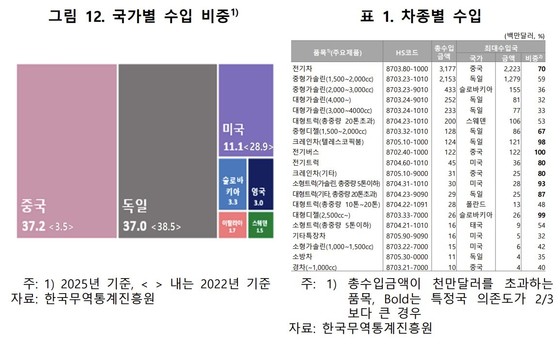
In stark contrast, the share of American cars in total imports plummeted from 28.9% to 11.1% during the same period.
The rise of Chinese automobiles has been particularly pronounced in the electric vehicle (EV) sector. Last year, a staggering 70% of EVs imported into South Korea were from China, totaling 2.22 billion USD. Moreover, Chinese suppliers completely dominated the electric bus market, with imports reaching 122 million USD.
China has expanded its footprint in the global automotive sector, leveraging its massive production capacity and price competitiveness. By 2024, China is projected to account for 33.8% of global automobile production, cementing its position as the world’s leading producer, while South Korea’s share stands at 4.5%.
In the export market, South Korean EV exports to the U.S. have significantly contracted due to increasingly stringent American protectionist policies.
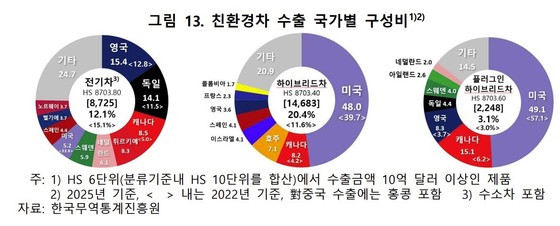
The U.S. share of South Korea’s total EV exports plummeted from 33.6% in 2022 to a mere 5.2% last year. Analysts attribute this steep decline to U.S. government policies aimed at boosting domestic production and imposing tariff barriers.
In response to the drop in EV exports, South Korean automakers have ramped up hybrid vehicle sales and increased local production in the U.S. The share of hybrid vehicles in total finished car exports rose from 11.6% in 2022 to 20.4% last year.
Semiconductor Exports Shift Toward Taiwan, Building AI Supply Chain with Nvidia and TSMC
The surge in AI has triggered significant shifts in semiconductor demand.
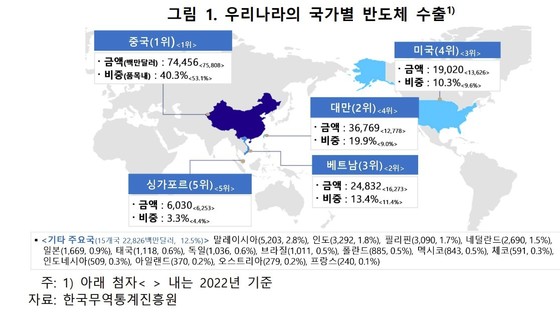
Taiwan, which ranked fourth as a semiconductor export destination for South Korea in 2022 with a 9.0% share, leaped to second place last year, capturing 19.9% of the market, trailing only China.
While China remains the largest destination for South Korean semiconductor exports, both its export volume and market share have decreased compared to 2022.
Vietnam and the U.S., home to numerous South Korean production facilities, have maintained their positions as major export destinations.
The pivot of South Korea’s semiconductor exports toward Taiwan is largely attributed to the proliferation of generative AI and increased investments in data centers.
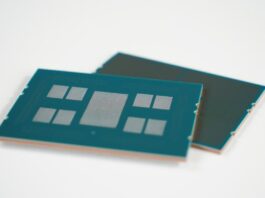
Semiconductor demand has shifted from traditional central processing units (CPUs) and general-purpose dynamic random access memory (DRAM) to graphics processing units (GPUs) specialized for AI computations and high-bandwidth memory (HBM). This transition has solidified a global AI supply chain linking U.S.-based NVIDIA (GPU design) with Taiwan’s TSMC (advanced packaging and foundry) and South Korea’s Samsung Electronics and SK Hynix (HBM production).
While South Korean companies have increased their production and export of HBM, the Bank of Korea notes that the market dominance of TSMC and NVIDIA has also strengthened.
The expansion of semiconductor production has led to a surge in imports of key materials, components, and equipment, intensifying dependency on specific countries.
A prime example is South Korea’s complete reliance on the Netherlands’ ASML for extreme ultraviolet (EUV) lithography equipment, where ASML holds a virtual monopoly. Consequently, the Netherlands’ share of semiconductor manufacturing equipment imports rose from 22.8% in 2022 to 26.0% last year, making it the largest supplier.
In light of these developments, the Bank of Korea observes that the global semiconductor industry is becoming increasingly vertically integrated, with specialization across value chains.
The Bank of Korea emphasizes that this comprehensive data provides valuable insights into regional production structures and global trade flows in manufacturing. This information can be instrumental in formulating policies and corporate strategies to enhance supply chain resilience against external shocks.
The Bank of Korea expresses hope that this report will serve as a crucial reference for policymakers, researchers, and corporate strategists in their decision-making processes.