

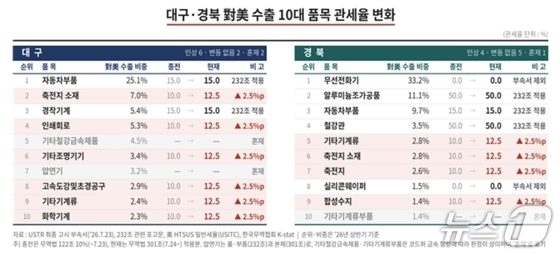
A recent analysis indicates that the 12.5% tariff on forced labor imports will have a limited impact on exports from Daegu and Gyeongbuk to the U.S.
This measure, which took effect on July 24, categorizes 60 economic zones based on their implementation of systems banning forced labor imports and imposes tariffs accordingly.
An urgent report from the Korea International Trade Association’s Daegu-Gyeongbuk Regional Headquarters reveals that 79.1% of the top ten export items from these regions to the U.S. are exempt from this measure, based on Harmonized System (HS) codes.
Automotive parts, processed aluminum products, and steel pipes, already subject to tariffs under Trade Expansion Act Section 232, are excluded from this additional tariff.
However, the proportion of U.S. exports for exempt items varies significantly between regions, with Gyeongbuk at 84.2% and Daegu at 49.6% for the first half of this year.
In Daegu, machinery and parts, including chemical machinery, lighting devices, high-speed steel, and carbide tools, face increased tariffs from 10% to 12.5%.
The trade association emphasizes the importance of individual companies verifying their HS codes, as the measure’s applicability is determined at this level.
For rolling machines, a complex situation arises where Trade Expansion Act Section 232 applies to rolls and parts, while Section 301 applies to the main body. This results in varying outcomes within the same product category. Companies facing difficulties in verification should utilize the U.S. Customs and Border Protection (CBP) pre-clearance system.
In the first half of this year, Daegu and Gyeongbuk exported 940 million USD and 4.73 billion USD to the U.S., respectively. The U.S. ranks as the second-largest export market for both regions after China, accounting for 19.2% of Daegu’s total exports and 22.4% of Gyeongbuk’s.
Kwon Oh-young, head of the trade association’s Daegu-Gyeongbuk headquarters, stated that while it anticipates the practical impact of this measure to be limited, it’s crucial for companies to verify the applicability based on their specific export product codes.