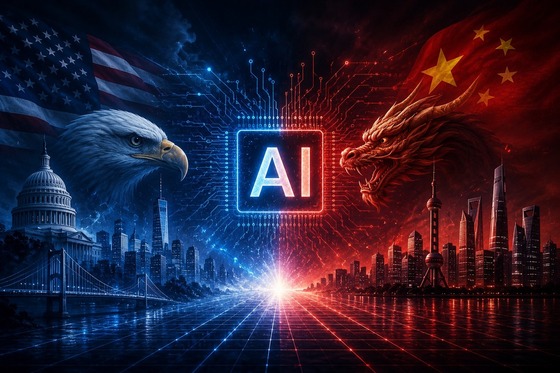
As China’s artificial intelligence (AI) technology advances more rapidly than anticipated, the U.S. is shifting its strategy to counter Chinese AI capabilities. Previously focused on controlling exports of AI semiconductors like graphics processing units (GPUs), the U.S. is now expanding its oversight to encompass the entire AI ecosystem, including AI models, development techniques, and critical data center components.
Industry reports from Monday indicate that Chinese AI firms are closing the technology gap with the U.S. faster than expected, prompting American officials to diversify their regulatory approach to maintain technological superiority.
The U.S. has historically restricted exports of high-performance GPUs and cutting-edge semiconductor equipment to impede China’s AI progress. This strategy aimed to maintain the technological gap by limiting access to computational resources crucial for AI model training.
However, experts now recognize that GPU regulations alone may not be sufficient to curb China’s AI growth.
A prime example is DeepSeek, which emerged in 2025. Despite U.S. export controls on advanced GPUs, DeepSeek unveiled a high-performance AI model, challenging the assumption that restricting GPUs would halt AI advancement.
Subsequently, several AI models capable of rivaling American tech giants have been introduced, including Zhipu AI’s GLM-5.2, Moonshot AI’s Kimi K3, and Alibaba’s Qwen 3.8 Max.
The rapid progress of Chinese AI has intensified concerns within the U.S.
Stanford University’s Human-Centered AI Institute (HAI) recently reported that China’s development of open-weight AI models is further narrowing the tech gap with the U.S. Clément Delangue, Chief Executive Officer (CEO) of Hugging Face, predicted in a recent interview that China could potentially catch up with the U.S. in frontier AI models by the end of this year or next, given the pace of Chinese AI development.
As Chinese AI enhances inference efficiency despite limited computing resources and gains competitiveness through open-weight strategies, the U.S. is adapting its containment methods.
Recently, both the U.S. government and AI industry have raised concerns about Chinese companies refining their models through distillation of American AI models. The U.S. administration is reportedly considering import restrictions on new Chinese-made optical transceivers for data centers.
This marks a shift from merely blocking GPU supplies to expanding regulatory measures across the entire AI ecosystem, including AI models, development techniques, and key data center components.
Kim Myung-joo, director of the AI Safety Research Institute, noted that as the tech gap narrows, U.S. concerns are growing. The belief that controlling GPUs would restrict AI training has been challenged by DeepSeek’s emergence. Now, they’re looking to extend oversight across the entire AI stack, including models and development techniques, not just hardware.
Professor Lee Jae-sung from Chung-Ang University’s AI department commented that while GPU restrictions remain somewhat effective, the U.S. seems to view current control levels as inadequate. Their strategy appears to be expanding regulations beyond AI infrastructure to software and models, aiming for their desired level of technological control.
He added that given the rapid progress of Chinese AI, U.S. containment measures are likely to intensify rather than ease in the future.
The strategic AI competition between the U.S. and China is expected to be a key topic at the upcoming U.S.-China summit next month.
Both nations are anticipated to discuss various issues, including AI safety, technological transparency, and international norms. With China’s AI capabilities advancing rapidly, this summit may serve as a crucial indicator of how both countries will manage AI as a global strategic asset, beyond mere technological rivalry.
Industry experts suggest that as the U.S. begins to view China not just as a challenger but as a key competitor, the future battle for AI dominance is likely to extend beyond semiconductors, encompassing the entire ecosystem including AI models, data centers, and software.