The U.S. may shift from controlling individual companies to a national-level approach in its semiconductor supremacy competition with China, according to recent suggestions. This change could significantly alter the impact of export sanctions based on alliance levels with the U.S.
Concerns have also surfaced that the U.S. could restrict semiconductor exports under the Export Administration Regulations (EAR). The EAR allows the U.S. government to require permits or impose restrictions on exports if products are made using U.S. technology or software, or in facilities that utilize American technology or software.
Korea Semiconductor Industry Association: Preparation for national-level export controls crucial
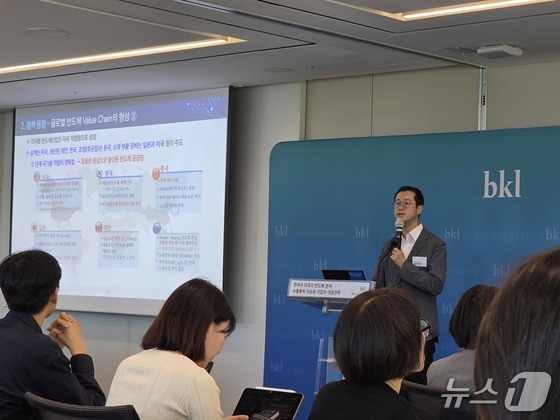
Lee Ji-han, Director of Strategic Planning at the Korea Semiconductor Industry Association, spoke at a seminar on export control issues in the semiconductor sector between Korea and the U.S. on Thursday morning. The event, hosted by law firm Taepyeongyang, focused on corporate response strategies. Lee noted that they’re likely seeing a shift from individual company controls to national-level dynamics. In the future, the impact of export sanctions could vary greatly based on inter-country alliances, which has significant implications beyond just individual companies.
Lee emphasized that while semiconductor manufacturing and research and development (R&D) excellence are crucial, failing to thoroughly examine the collaborative structure between companies and nations could increase uncertainty in maintaining semiconductor competitiveness.
He added that semiconductors have become a tool for warfare and sanctions, with a single chip playing a critical role. The semiconductor chip itself is now generating various collaborative elements in international competition and alliances.
Lee pointed out that countries are developing strategies to secure semiconductor supply chain dominance following the COVID-19 pandemic. He explained that the U.S. has prioritized supply chain localization due to severe semiconductor shortages and potential threats to its industries if stable supply can’t be ensured. This marked the beginning of a significant push for domestic supply chains.
U.S. Expands EAR and FDPR: Semiconductor Firms Urged to Assess Export Control Risks
Hwang Hyo-seong, Director of the Taepyeongyang Export Control Response Center, stressed the importance of U.S. export control regulations (EAR) for the semiconductor industry.
The EAR outlines control rules for U.S. exports of specific technologies, products, or software. Overseen by the Bureau of Industry and Security (BIS) of the U.S. Department of Commerce, these regulations may require U.S. government permits or impose restrictions on exports to certain countries or companies.
Hwang highlighted the Foreign Direct Product Rules (FDPR) as a key category impacted by the EAR in the semiconductor industry.
The FDPR applies to products made using U.S. technology or software, or in facilities utilizing American technology or software. For example, semiconductors produced in Korea using U.S. equipment could fall under the FDPR if they meet specific criteria.
Hwang predicts that U.S. export controls will become increasingly sophisticated. He stated that current U.S. export controls go beyond any single administration’s policies. The core of the U.S.-China supremacy competition centers on semiconductor sector dominance.
He explained that to maintain its edge over China, the U.S. is aligning other countries with its interests. The U.S. will leverage the FDPR to ensure allied and partner countries comply with its export controls and incorporate U.S. export control laws into their own systems.
Hwang added that all semiconductor players must comply with U.S. semiconductor export control EAR. Companies involved in semiconductor manufacturing, design, equipment, and related fields should verify EAR compliance to mitigate risks in semiconductor exports.
The seminar was co-hosted by the Taepyeongyang Export Control Response Center and U.S. global law firm Reed Smith LLP. Established in 2025, the center aims to assist companies navigating increasingly complex export and import activities amid rapidly changing international circumstances and tightening regulations.
In his welcoming remarks, Lee Jun-ki, the representative attorney of Taepyeongyang, stated that the convergence of technological supremacy, economic security, and supply chain restructuring has created a complex equation for businesses. If it can’t avoid this complexity, it must manage risks while addressing each variable to achieve business success.