

The International Energy Agency (IEA) projects that by 2035, half of all new global car sales will be electric vehicles (EVs), with cumulative sales expected to reach 500 million units.
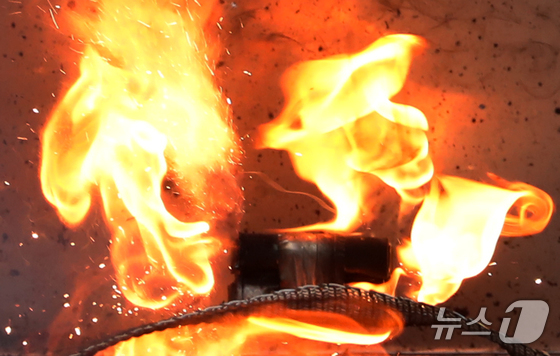
Despite the increasing adoption of EVs, the thermal runaway issue in lithium-ion batteries remains unresolved. Within seconds, temperatures can soar above 1,000 degrees Celsius (1832 degrees Fahrenheit), and missing the critical 10-second window to address this can lead to uncontrollable situations.
While some security and fire suppression systems are being developed to detect early signs of thermal runaway, these are merely stopgap measures. A long-term solution requires the development of flame-retardant electrolytes.
As of Thursday, the scientific community reports that in 2023, the Korea Institute of Science and Technology (KIST), in collaboration with the Energy Storage Research Center and the Korea Institute of Industrial Technology (KITECH), developed a flame-retardant electrolyte known as BMEC.
The research team achieved this breakthrough by manipulating the molecular structure of linear organic carbonate. Conventional electrolytes using linear organic carbonate solutions are highly flammable due to their low flash point, even at room temperature.
Common methods to enhance electrolyte flame resistance involve substituting a large number of fluorine atoms into the electrolyte molecules or dissolving high concentrations of salts.
However, these methods often reduced ion conductivity or poor compatibility with commercial electrodes, making them less viable for cost-effective mass production.
In contrast, KIST’s BMEC was developed by simultaneously applying alkyl chain extension and alkoxy substitution to organic carbonate molecules. This increased intermolecular interactions and lithium salt solubility, simultaneously improving flash point and ionic conductivity (the speed of ion movement).
In practice, BMEC’s flash point is 30 degrees Celsius (86 degrees Fahrenheit) higher than conventional electrolytes, but it emits 37% fewer flammable gases.
However, the research is still in the experimental stage. It proposes a new method for flame-retardant electrolytes, but it has not yet achieved the charging efficiency of commercial lithium batteries.
South Korea’s three major battery manufacturers—LG Energy Solution, Samsung SDI, and SK On—are researching solid-state batteries using solid electrolytes like ceramics as an alternative.
These also face challenges due to low ionic conductivity, reducing output and charging efficiency.
Additionally, the production cost per kilogram of solid electrolytes is approximately $11,040, 1,200 times more expensive than lithium electrolytes, making them economically unfeasible.
Another challenge is the need to overhaul existing battery manufacturing processes and production infrastructure altogether. Even if new electrolyte materials are developed, private companies may hesitate to adopt them. Industry experts suggest considering legislative support to promote the adoption of non-flammable batteries.