

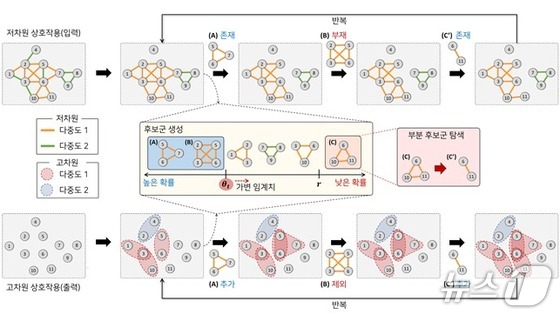
The Korea Advanced Institute of Science and Technology (KAIST) announced on Tuesday that a research team led by Professor Shin Gi-jeong at the Kim Jaechul Graduate School of AI has developed an artificial intelligence (AI) technology called MARIOH. This innovative system can accurately reconstruct high-dimensional interaction structures using only low-dimensional interaction information.
High-dimensional interactions enable the modeling of complex multi-party relationships beyond simple connections between two entities, allowing for a more comprehensive understanding and utilization of relationships.
Examples include multiple authors collaborating on a paper, a single email sent to multiple recipients, or several proteins interacting simultaneously.
The challenge lies in the vast number of potential high-dimensional interactions that can be derived from low-dimensional interaction structures, making reconstruction difficult.
MARIOH’s core innovation is its use of multiplicity information from low-dimensional interactions to significantly reduce the number of potential high-dimensional interaction candidates.
The system employs efficient search techniques to quickly identify promising interaction candidates and uses multiplicity-based deep learning to accurately predict the likelihood of each candidate representing an actual high-dimensional interaction.
In experiments across ten diverse real-world datasets, the research team found that MARIOH reconstructs high-dimensional interactions with up to 74% greater accuracy than existing technologies. For co-authorship relationship data, MARIOH achieved over 98% reconstruction accuracy, far surpassing current technologies that typically achieve around 86%. Moreover, using the reconstructed high-dimensional structures improved performance in various tasks, including prediction and classification.
Professor Shin explained that MARIOH represents a shift from traditional approaches that relied solely on simplified connection information. Further noting that it opens up possibilities for accurately leveraging complex real-world connection relationships. He added that this technology has broad potential applications in fields such as social network analysis, life sciences, and neuroscience.
The research, co-authored by Lee Gyu-han and Lee Geon, doctoral candidates at KAIST’s Kim Jaechul Graduate School of AI, and Professor Shin, was presented at the 41st IEEE International Conference on Data Engineering (IEEE ICDE) held in Hong Kong last May.