Samsung Medical Center has been named the top hospital in the Asia-Pacific region for cancer, respiratory and digestive care in a specialty hospital ranking published by global news magazine Newsweek.
The hospital announced June 18 that it ranked No. 1 in cancer, respiratory and digestive care in Newsweek’s “World’s Best Specialized Hospitals Asia-Pacific 2026” rankings, released June 17.
The evaluation was conducted by Newsweek in partnership with German market research firm Statista and was based on surveys of medical professionals across 11 Asia-Pacific countries, including South Korea, Japan, Australia, Taiwan, Singapore and Thailand. The assessment also incorporated national healthcare accreditation data and Patient-Reported Outcome Measures (PROMs).
The rankings covered 10 specialties: cancer, respiratory care, digestive care, cardiology, endocrinology, neurology, orthopedics, pediatrics, cardiac surgery and neurosurgery. Digestive care was added as a new category this year.
Samsung Medical Center ranked first in both cancer and respiratory care for the third consecutive year since 2024. It also claimed the top spot in digestive care in the category’s inaugural year, completing a three-category sweep.
“We have focused on treating severe and highly complex diseases while continuously improving the quality of our research and clinical care,” said Park Seung-woo, president of Samsung Medical Center. “We will continue pursuing innovations in future medicine so that the path we take can become a new standard for healthcare.”
The hospital’s strength in cancer care was particularly notable. In Newsweek’s global specialty hospital rankings published last year, Samsung Medical Center ranked third worldwide in oncology. Given that the first- and second-ranked institutions—Memorial Sloan Kettering Cancer Center and MD Anderson Cancer Center—are dedicated cancer hospitals, the result is widely viewed as recognition of Samsung Medical Center’s standing among the world’s leading general hospitals.
Samsung Medical Center opened Asia’s largest cancer hospital housed within a single building in 2008. It has led advances in cancer treatment by becoming the first hospital in South Korea to introduce CAR-T cell therapy and by implementing precision oncology programs for patients without established standard treatment options.
The overall five-year survival rate among cancer patients treated at Samsung Medical Center’s Cancer Center stands at 75.4%, among the highest reported globally.
More recently, the hospital has expanded its focus beyond treatment outcomes to improving quality of life for cancer patients. In June of last year, it established the Cancer Patient Quality of Life Research Institute in partnership with Samsung Fire & Marine Insurance and has regularly hosted joint seminars on Patient-Reported Outcomes (PROs) with Germany’s Charité Hospital.
The hospital is also collaborating with the European Organisation for Research and Treatment of Cancer (EORTC) on the translation standardization and quality management of Korean PRO tools. In addition, it became the first institution in South Korea to earn certification from the International Consortium for Health Outcomes Measurement (ICHOM), which promotes global standards for value-based healthcare.
In respiratory medicine, the hospital has demonstrated strengths across the full spectrum of severe respiratory diseases, including lung cancer, chronic obstructive pulmonary disease (COPD), nontuberculous mycobacterial lung disease, interstitial lung disease and lung transplantation.
Samsung Medical Center performs more than 1,500 lung cancer surgeries annually, with over 90% conducted using minimally invasive approaches such as robotic surgery and video-assisted thoracoscopic surgery. The hospital’s 30-day postoperative mortality rate is approximately 0.1%.
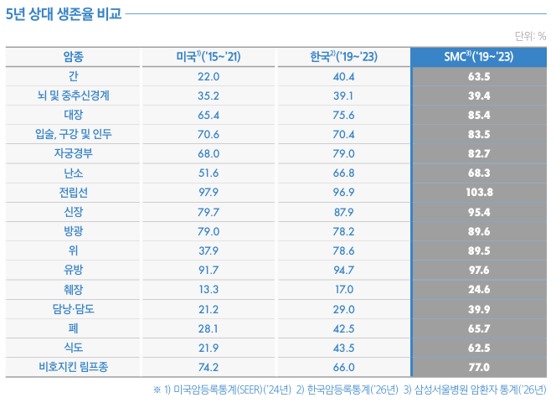
The five-year survival rate for lung cancer patients is 65.7%, significantly higher than both the South Korean average of 42.5% and the U.S. average of 28.1%.
The hospital recently developed RADAR CARE, a model capable of predicting recurrence in early-stage non-small cell lung cancer patients up to one year in advance. In March, it also introduced a robotic bronchoscopy system capable of precisely diagnosing small pulmonary nodules.
The hospital performs more than 1,600 endobronchial ultrasound procedures annually and is approaching a cumulative total of 20,000 cases. It also conducts more than 200 rigid bronchoscopy procedures each year.
In the COPD field, Samsung Medical Center became the first hospital in South Korea in 2022 to implement mobile-based Patient-Reported Outcomes assessments for all patients and currently operates a year-round monitoring program for severe cases.
The hospital is also accelerating development of artificial intelligence models that combine voice information with clinical data to predict declines in lung function and disease exacerbation risk.
The newly introduced digestive care category also recognized the hospital’s treatment outcomes for severe diseases including esophageal cancer, pancreatic cancer, stomach cancer and liver cancer.
Samsung Medical Center treats diseases of the esophagus, stomach, colon, liver, pancreas and gallbladder through a multidisciplinary care system involving specialists from gastroenterology, thoracic surgery, gastrointestinal surgery, hepatobiliary-pancreatic surgery and colorectal surgery.
In esophageal cancer care, the hospital treats 22.2% of all patients diagnosed nationwide and performs 89.3% of surgeries using minimally invasive techniques such as robotic and video-assisted thoracoscopic surgery.
The hospital’s 30-day postoperative mortality rate for esophageal cancer is 0%, while its five-year relative survival rate is 62.5%, significantly exceeding both the South Korean average of 43.5% and the U.S. average of 21.9%.
Its five-year relative survival rate for pancreatic cancer is 24.6%, compared with 17.0% nationally and 13.3% in the United States. The hospital is also developing AI-based prognostic prediction models for pancreatic and gallbladder cancers.
In stomach cancer care, Samsung Medical Center became the first institution in the world in 2019 to demonstrate the effectiveness of genomics-based personalized treatment strategies and now performs more than 700 endoscopic procedures annually for patients with early-stage gastric cancer.
In liver cancer treatment, the hospital has demonstrated the effectiveness of proton therapy for patients who are not suitable candidates for standard treatment approaches. In September of last year, it became the first hospital in South Korea to surpass 2,000 proton therapy cases for liver cancer.
In colorectal cancer care, the hospital offers proton therapy to patients with unresectable liver metastases and recurrent rectal cancer, while expanding endoscopic treatment options for patients with inflammatory bowel diseases such as Crohn’s disease as an alternative to surgery.
Samsung Medical Center was also ranked third worldwide in oncology for the second consecutive year in Newsweek’s “World’s Best Specialized Hospitals” rankings released last year. Considering that the top two institutions specialize exclusively in cancer treatment, Samsung Medical Center is effectively regarded as the world’s highest-ranked general hospital in oncology. Among Asia-Pacific hospitals, it has maintained the No. 1 position for four consecutive years.