
As South Korea’s financial regulators prepare to tighten KOSDAQ delisting requirements next month, biotech companies listed through the technology-special listing program are facing growing pressure. Industry observers, however, say the more immediate threat is not delisting but running out of cash. Developing innovative medicines typically requires tens to hundreds of millions of dollars, and a weaker investment environment has made fundraising increasingly difficult.
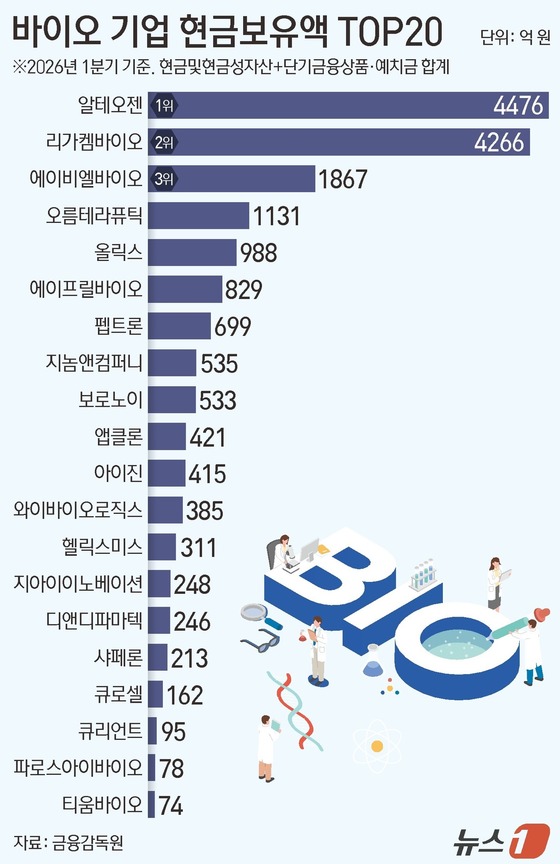
An analysis of 20 major biotech companies listed under the technology-special program found that six companies may struggle to operate for more than one year without securing additional financing.
Cash-equivalent assets were calculated by combining cash and cash equivalents, short-term financial instruments and bank deposits, excluding restricted assets. Estimated cash runway was calculated by dividing available cash-equivalent assets by operating cash outflows over the previous 12 months.
The analysis showed that Qurient had the shortest estimated cash runway at 0.33 years. Other companies with less than one year of runway included TiumBio (0.48 years), Curocell (0.54 years), Voronoi (0.74 years), GI Innovation (0.77 years) and Pharos iBio (0.93 years).
Including D&D Pharmatech (1.16 years) and Shaperon (1.47 years), eight companies—representing 40% of those analyzed—had less than two years of estimated cash runway based solely on current cash reserves.
By contrast, companies that have successfully licensed technologies to global pharmaceutical partners generally maintained stronger balance sheets. Alteogen reported approximately $325 million in cash-equivalent assets and an estimated runway of 3.61 years, while LigaChem Biosciences held about $310 million and ABL Bio approximately $136 million.
Other companies with relatively strong cash positions included Orum Therapeutics with roughly $82 million in cash-equivalent assets, OliX Pharmaceuticals with about $72 million and AprilBio with approximately $61 million.
Technology Licensing Creates a Financial Divide
The gap in financial strength between companies with and without licensing deals has become increasingly apparent. Alteogen, LigaChem Biosciences and ABL Bio have all secured licensing agreements with global pharmaceutical companies, allowing them to build substantial cash reserves through upfront payments and milestone revenue.
Many smaller biotech firms, meanwhile, continue to rely heavily on secondary stock offerings and convertible bond issuances for funding. Industry participants say that when investor sentiment weakens or clinical trials disappoint, access to capital can quickly become constrained, making technology-licensing success a critical determinant of financial stability.
The recent case of Bridge Biotherapeutics illustrates the challenges facing the sector. Following a series of clinical setbacks and financing difficulties, the company recently announced plans to enter the Bitcoin treasury business after a change in controlling shareholders. The move drew attention because the company had originally been established as a drug-development-focused biotech venture.
Investors view such developments as evidence of broader pressures across the biotechnology financing ecosystem. Companies with promising technologies but limited commercial revenue are finding it increasingly difficult to secure capital as funding conditions tighten.
From Ideas to Cash: Investment Priorities Shift
Market participants generally regard deteriorating financing conditions as a more significant risk than stricter listing requirements. Because biotech companies typically spend far more on research and development than they generate in revenue, disruptions to financing can directly affect clinical development timelines and pipeline progress.
Investment criteria have also evolved significantly. Whereas technological potential and growth prospects were once sufficient to attract capital, investors now place greater emphasis on cash reserves, clinical progress and the likelihood of future licensing agreements.
A venture capital industry source said investment decisions increasingly favor companies that already possess substantial cash resources and have demonstrated meaningful progress in advancing their development pipelines.
Several companies identified as having less than one year of cash runway have recently secured additional financing. Curocell raised approximately $53 million, while Voronoi issued roughly $36 million in convertible bonds. Companies that have yet to demonstrate meaningful clinical results or commercialization potential, however, continue to face increasing fundraising challenges.
Stronger Investment Ecosystem Needed Alongside Delisting Reforms
Industry participants broadly support stricter delisting standards as a way to improve market quality. However, many argue that reforms should be accompanied by measures to strengthen the investment ecosystem supporting technology-special listed companies as they advance through lengthy clinical development programs.
The technology-special listing framework was designed to allow innovative companies with strong technologies but limited profitability to access public capital markets. Critics argue that while the listing pathway exists, long-term financing support for post-listing clinical development remains insufficient.
Potential solutions include expanding investment support for early- and mid-stage biotechnology companies. Although the government has launched biotechnology and vaccine investment funds and late-stage clinical trial funding programs, industry observers say a sustainable ecosystem will require capital support extending beyond Phase 3 trials to include Phase 1 studies and proof-of-concept development.
Some also warn that if stricter delisting standards further weaken investor sentiment at a time when biotech startup formation is already slowing, the broader innovation ecosystem could come under additional strain. Rather than focusing solely on removing underperforming companies, they argue, policymakers should also consider mechanisms that ensure promising biotechnology firms can access capital when it is most needed.