The National Research Institute of Cultural Heritage’s Cultural Heritage Conservation Science Center has completed the restoration of a historic Korean flag, officially recognized as national cultural heritage. This flag, which once graced the Waldorf Astoria Hotel in New York, was reportedly used during a Korean independence dinner hosted by former President Syngman Rhee in 1942. After meticulous treatment to address stains, discoloration, and torn seams, it’s now set to return to its home at the National Assembly Records Center.
Crafted in the 1930s by the Copeland Company, a renowned American flag manufacturer, this artifact is a testament to pre-liberation Korean flag-making techniques used abroad and serves as a tangible piece of independence movement history. The white fabric showcases intricate embroidery of the Taeguk symbol and four trigrams. Adding to its authenticity, brass rings for flagpole attachment adorn the top and bottom of the hoisting side.
A detailed analysis revealed the flag’s complex construction: the hoisting side features a twill weave skipping over two or more cotton yarn strands, while the flag’s main body uses a plain weave of twisted yarns. Interestingly, the Taeguk and trigrams also employ a plain weave, highlighting the varied weaving techniques used throughout the flag.
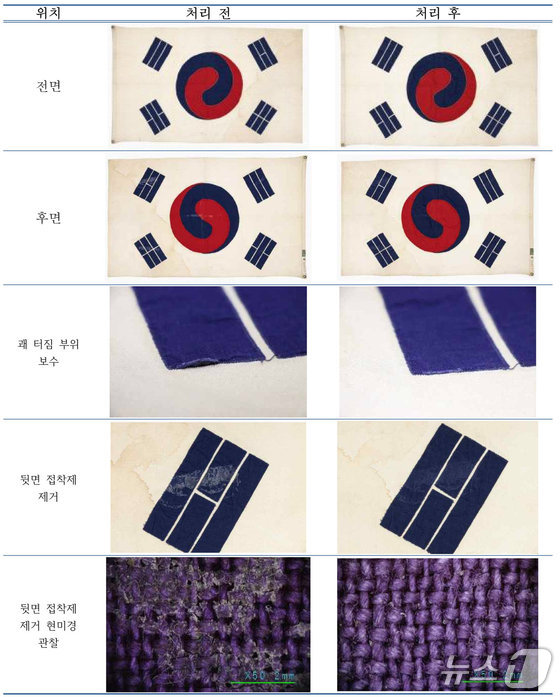
Before restoration, the flag’s condition was far from ideal. Yellowed from age and fixed within a frame, it bore the marks of time. The right side, featuring the Gon and Lee trigrams, showed noticeable moisture stains. The Taeguk pattern and four trigrams weren’t spared either, with visible folds, wrinkles, and even torn seams in some areas.
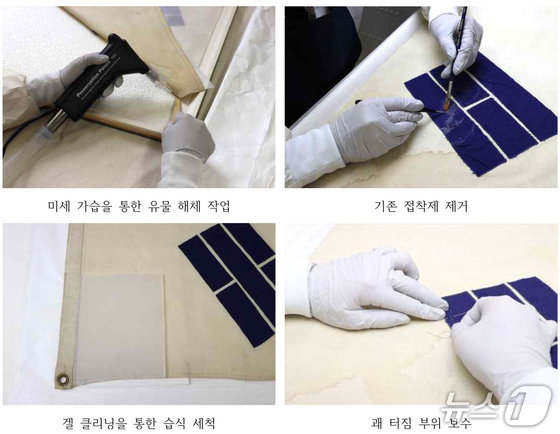
The restoration process began with the delicate task of separating the flag from its frame and removing adhesive residue from the back. To address the wrinkles, conservators used a fine mist to gently humidify affected areas before applying careful pressure to smooth out the fabric.
Surface contaminants were meticulously removed using a combination of soft brushes and vacuum suction. For more stubborn stains, the team employed a partial wet cleaning method using agarose gel. This innovative substance, derived from red algae, is a game-changer in conservation, allowing for effective cleaning while minimizing moisture spread.
Special attention was given to the torn trigram areas, with reinforcements added along existing seams to ensure the repairs blended seamlessly with the original fabric. This painstaking restoration, made possible through lottery funding, has breathed new life into this symbol of Korean heritage. Now, the flag will find its new home at the National Assembly Records Center, where it will be carefully preserved and made available for future study. Meanwhile, the Cultural Heritage Conservation Science Center continues its vital work, developing tailored preservation techniques for various cultural artifacts.