Inventage Lab has unveiled groundbreaking research findings for its drug delivery platform, capable of developing ultra-high concentration subcutaneous injection formulations for antibodies and antibody-drug conjugates (ADCs).
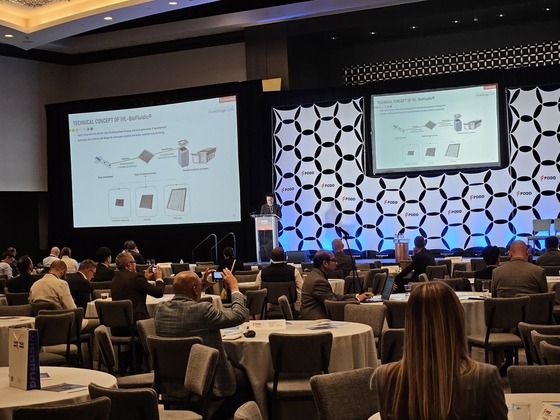
The company presented its research outcomes for the IVL-BioFluidic platform, designed for ultra-high concentration biopharmaceutical subcutaneous injections, at the global drug delivery conference PODD 2026 in Boston on Friday.
The presentation featured non-clinical data validating the structural and functional analysis of antibody and ADC particles, pharmacokinetics (PK) after subcutaneous administration, stability, and injectability of high-concentration suspensions.
Inventage Lab successfully applied its platform to three antibody drugs – rituximab, trastuzumab, and bevacizumab – as well as the ADC trastuzumab deruxtecan, achieving particle formation.
Analysis of the reconstituted particle-formed drugs showed minimal structural or functional differences compared to existing reference drugs, maintaining both efficacy and stability.
Notably, when administered subcutaneously to animals using a 25-gauge needle, the particle-formed drug suspensions exhibited similar absorption and distribution patterns to existing formulations.
These non-clinical results suggest the potential for delivering high-concentration biopharmaceuticals via subcutaneous injection while preserving the characteristics of existing drugs.
The shift towards subcutaneous injection formulations for antibody drugs is a hot trend in the global pharmaceutical industry. This approach can significantly reduce administration times compared to intravenous injections and minimize hospital stays, improving patient convenience and healthcare efficiency.
Inventage Lab is leveraging its microfluidic core technology, originally developed for long-acting injectables, to expand into antibody drugs. The company’s strategy involves applying precision particle control techniques to develop formulations for high-concentration biopharmaceuticals.
The firm has also prioritized intellectual property protection. Since 2024, it has conducted extensive patent and freedom-to-operate (FTO) analyses, recently completing international patent applications under the Patent Cooperation Treaty (PCT).
This effort aims to build a robust patent portfolio protecting both the microfluidic manufacturing process and the unique characteristics of uniform particles in formulations.
Global commercialization efforts are underway. Inventage Lab has signed six material transfer agreements (MTAs) with domestic and international partners to evaluate the technology’s applicability. At the recent conference, the company engaged in discussions with major global pharmaceutical firms regarding candidate evaluations and future collaborations.
An Inventage Lab spokesperson stated that its presentation highlighted key data linking antibody and ADC particle formation to in vivo delivery post-subcutaneous administration. It’s poised to accelerate global co-development and technology transfer discussions, leveraging the precision particle control technology, extensive manufacturing experience, and strategic patent approach.