

On Monday, OpenAI introduced its latest suite of artificial intelligence models to developers: GPT-4.1, along with its streamlined versions, GPT-4.1 Mini and GPT-4.1 Nano.
These cutting-edge models are now accessible exclusively for developers through OpenAI’s application programming interface (API).
GPT-4.1 is the latest iteration of OpenAI’s multimodal AI model, succeeding last year’s GPT-4o. The company reports significant improvements in coding capabilities, with GPT-4.1 outperforming GPT-4o by 21% and GPT-4.5 by 27%.
In the SWE-bench Verified benchmark, GPT-4.1 achieved an impressive score of 54.6%, substantially surpassing GPT-4o’s 33.2%.
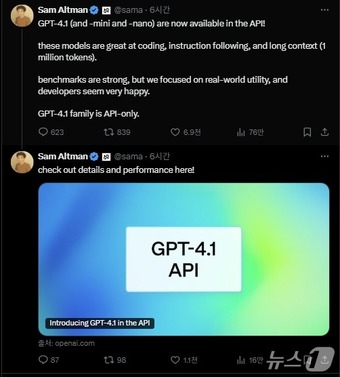
OpenAI CEO Sam Altman took to X to highlight the strengths of the GPT-4.1 family. He emphasized their exceptional performance in coding tasks, following complex instructions, and processing extensive contexts of up to one million tokens. Altman noted the positive reception from developers, attributing it to the models’ focus on practical usability.
A standout feature of these new models is their enhanced contextual understanding. All three variants can process up to one million tokens of context, a significant leap from GPT-4o’s capacity of 128,000 tokens – effectively an eightfold increase in processing power.
For developers seeking cost-effective experimentation, GPT-4.1 Mini offers an attractive option. It slashes token costs by 83% compared to GPT-4o, making it an accessible choice for various applications.
GPT-4.1 Nano stands out as OpenAI’s most compact and affordable model to date. It’s expected to excel in tasks such as classification, auto-completion, and AI agents implementation.
OpenAI has introduced competitive pricing for these new models. GPT-4.1 is priced at 2 USD per million input tokens and 8 USD per million output tokens, marking a 26% reduction from GPT-4o’s rates. GPT-4.1 Mini comes in at 0.40 USD and 1.60 USD per million input and output tokens, respectively, while GPT-4.1 Nano is priced at just 0.10 USD per million input and 0.40 USD per million output tokens.
The company also announced plans to phase out GPT-4.5 in July, citing GPT-4.1’s significantly lower operational costs.
GPT-4.5 had been widely recognized as a model that showed the limitation of scaling laws, particularly due to its high costs, including API usage fees. Altman had previously described it as a “giant, expensive model” upon its release.
Kevin Weil, OpenAI’s Chief Product Officer, reflected on GPT-4.5, characterizing it as a very successful experiment despite its limitations.
Looking ahead, OpenAI has plans to release new inference models, including o3 and o4 Mini versions, in the near future.