

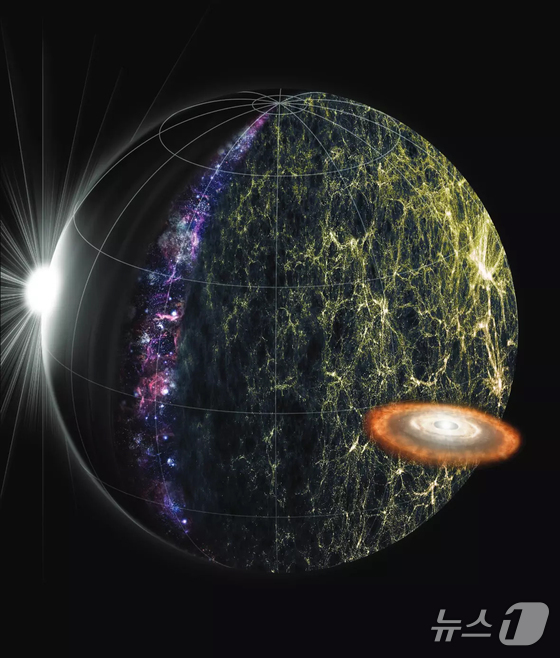
The South Korean astronomy community has set its research goals for the next decade, identifying the unraveling of cosmic evolution, particularly the understanding of dark energy and dark matter, as key priorities. It also emphasizes the importance of investigating how life forms, including humans, emerged in the universe and exploring the potential existence of extraterrestrial life.
On Monday, the Korean Astronomical Society released a long-term development report outlining the mid- to long-term vision for Korean astronomy. The report was led by the society’s Long-Term Development Committee and supported by the Korea Aerospace Administration. Over the past eight months, more than 80 astronomers and around 10 advisors, including Professor Im Myung Shin of Seoul National University’s Department of Physics and Astronomy, contributed to the report.
The report presents bold research topics that Korean astronomy should prioritize from 2026 to 2035. It also covers the current state and prospects of research infrastructure, public outreach in astronomy, and strategies for nurturing future talent.
Among its key goals, the report first highlights the need to understand the universe’s past and future. To achieve this, core tasks include verifying physical laws, such as various cosmic models and gravitational theories that illustrate the universe’s evolution. It also calls for the identification of the nature of dark energy and dark matter, as well as studies on the historical development of galaxies and black holes.
Another primary objective is uncovering the origin of humanity from a cosmic perspective.
The essential elements that make up life are formed during the life and death cycles of stars. A central task is to determine how these building blocks of life are produced in space and to search for potentially habitable exoplanets.
The report emphasizes that addressing such complex scientific challenges requires a range of observational infrastructure.
Specifically, it outlines the need for next-generation ground-based telescopes capable of observing across different wavelengths, facilities that utilize non-light messengers such as gravitational waves and neutrinos, and space-based platforms like space telescopes.
It also emphasizes the need to build high-capacity data storage and analysis systems, as well as advanced computing infrastructure, to process massive datasets and perform theoretical calculations.
Professor Im Myung Shin, who led the long-term study, noted that many countries, including the United States, regularly issue 10-year plans like this to guide the development of astronomy. He expressed hope that Korean astronomy would make significant strides over the next decade.
This publication is a preliminary version of the report, and a final version containing detailed descriptions of the proposed projects is expected to follow.