

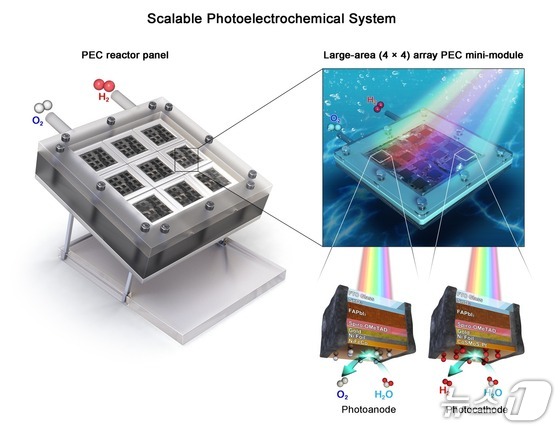
Researchers at the Ulsan National Institute of Science and Technology (UNIST) have developed a groundbreaking modular artificial leaf that combines high efficiency, durability, and scalability. The team, led by Professors Lee Jae Sung, Seok Sang Il, and Jang Ji Wook from the School of Energy and Chemical Engineering, announced their findings on Sunday.
This innovative artificial leaf technology produces hydrogen using only sunlight and water, mirroring natural processes without the need for external power sources. It represents a leap forward in green hydrogen production, generating no carbon dioxide emissions during the process.
Unlike traditional solar cell-based electrolysis methods, this system bypasses the electricity generation phase, directly converting light energy into chemical energy. This novel approach minimizes energy losses due to inter-system resistance and reduces the required installation area.
Previous attempts at artificial leaf technology have faced hurdles in commercialization due to low efficiency, limited durability, and scalability issues.
The UNIST team overcame these challenges by creating a high-efficiency photoelectrode at 1 cm² using a perovskite-based solar absorption layer and nickel-iron-cobalt catalysts. They then scaled this up into a modular artificial leaf arranged in a 4×4 configuration.
This innovative module can produce hydrogen consistently using only sunlight, without any additional power source. The team achieved an impressive overall solar-to-hydrogen conversion efficiency of 11.2% for the entire module.
This efficiency marks a new record for artificial leaves and represents a significant milestone in the field. The researchers emphasize the importance of surpassing the 10% efficiency threshold at the module scale, a crucial benchmark for commercial viability.
The team attributes their success in achieving high efficiency and stability to a carefully engineered combination of materials. These include chlorine-doped perovskite light-absorbing layers (Cl:FAPbI₃), ultraviolet-resistant electron transport layers (Cl:SnO₂), and catalyst layers (NiFeCo).
To enhance durability, the researchers implemented special nickel foil and resin encapsulation technologies. These innovations protect the electrodes from moisture damage, enabling the system to maintain 99% of its initial performance even after 140 hours of continuous operation.
Professor Lee highlighted the commercial potential of their work, stating that this modular artificial leaf panel can be scaled up to large areas, much like conventional solar panels, which represents a crucial breakthrough towards commercialization.
The groundbreaking research has been published in the prestigious international journal Nature Communications.