
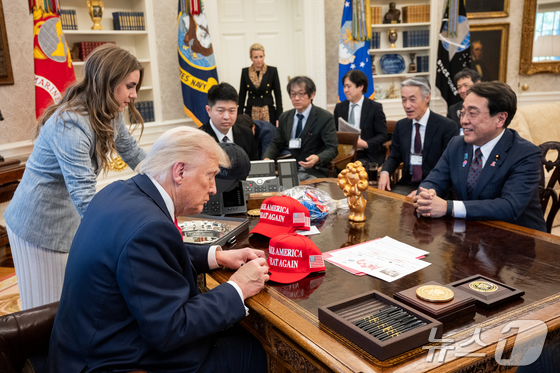
On September 4, Ryosei Akazawa, Japan’s Minister of Economic Revitalization overseeing U.S.-Japan negotiations, held a press conference in Washington. He reaffirmed that Japan had secured Most-Favored Nation (MFN) status for pharmaceuticals and semiconductors. However, the executive order signed by President Donald Trump lacks these provisions, raising questions about the underlying reasons. Some speculate that the Trump administration may use potential tariffs on items like semiconductors as leverage in future negotiations.
Reuters reports that Akazawa’s press conference followed Trump’s signing of an executive order. This order modified the previous additional 15% mutual tariff order on Japan, effective from early August, to a flat 15%. It also formalized the reduction in auto tariffs (from 27.5% to 15%) that had been agreed upon with Japan in July.
Akazawa, who visited the U.S. on July 22 to document the trade agreement, explained that the joint statement included provisions to protect Japan from facing disadvantageous tariffs on pharmaceuticals or semiconductors compared to other countries. However, the executive order released by the White House omits this provision.
For pharmaceuticals, the agreement aims to eventually eliminate tariffs on Japanese generic drugs, their raw materials, and natural resources not produced in the U.S. It also provides for waiving steel, aluminum, and copper tariffs on aircraft and parts manufactured in Japan. Notably, semiconductors are not mentioned.
Reuters noted that Akazawa plans to continue pressuring the U.S., as the executive order excludes MFN treatment for pharmaceuticals and semiconductors. This suggests that Trump deliberately omitted these provisions from the joint statement in his executive order.
On that day, the U.S. and Japan issued a joint statement reaffirming their July agreement and signed a memorandum on Japanese investment in the U.S. However, neither document has been made public, leaving only the Japanese government’s explanation available.
Previously, the European Union (EU) secured and documented a U.S. commitment to cap tariffs on pharmaceuticals and semiconductors at 15%. The U.S.-EU joint statement from July 21 pledged that the U.S. would swiftly ensure that the combined tariff rate (MFN plus Section 232 tariffs) on EU pharmaceuticals, semiconductors, and wood would not exceed 15%.
This means that even if the U.S. Department of Commerce’s Section 232 investigation determines that certain imports threaten national security and sets new tariffs, EU product tariffs will remain capped at 15%.
The absence of MFN clauses for semiconductors or pharmaceuticals in the U.S.-Japan trade agreement executive order may be a strategic move by the U.S. Analysts suggest that this could give the Trump administration room for further negotiations on these items, for which specific tariff plans have not yet been announced.
Coincidentally, during a White House event with U.S. tech executives on the same day, President Trump announced plans to impose substantial tariffs on semiconductor companies that do not build factories in the U.S. He added that companies entering, planning to enter, or constructing factories in the U.S. would be exempt from these tariffs.
Discrepancies between U.S. and Japanese explanations regarding investments in the U.S. continue to fuel controversy.
Trump’s executive order claims that, unprecedented in U.S. history, the Japanese government agreed to invest 550 billion USD in the U.S. It states that the U.S. government will select investment destinations, promising hundreds of thousands of new jobs, expanded domestic manufacturing, and long-term American prosperity.
At the press conference, Akazawa maintained that there were no changes to U.S. investment plans since the July agreement. He explained that Japan would provide investments, loans, and loan guarantees totaling up to 550 billion USD, and noted that entities such as the Japan Bank for International Cooperation (JBIC) and Nippon Export and Investment Insurance (NEXI) would support projects deemed beneficial to Japan.
Takahide Kiuchi, an economist at Nomura Research Institute (NRI), noted in a report that the Trump administration has consistently portrayed the deal as Japan providing 550 billion USD, with the U.S. government directing investments to revive and expand U.S. manufacturing.
Kiuchi pointed out that the Japanese government’s explanation differs significantly. Japan states that when Japanese companies independently decide to invest in the U.S., government financial institutions will support these investments, loans, and loan guarantees up to 550 billion USD. He emphasized that the two countries appear to be describing entirely different frameworks.


