

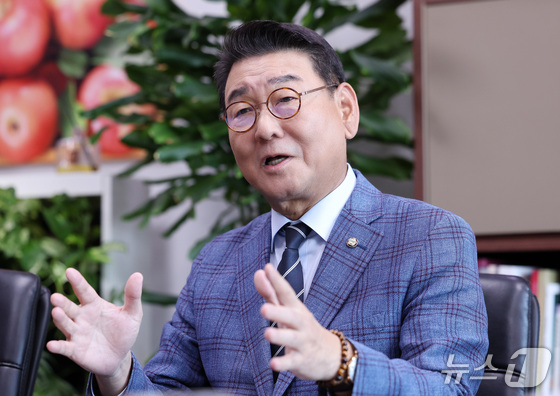
“Thirty-eight people in South Korea take their own lives every day — enough to fill an entire classroom. It is deeply tragic that suicide, rather than cancer or other diseases, is the leading cause of death among people in their teens through their 40s. Suicide deaths have not continued because they are impossible to prevent, but because the country has failed to commit the resources needed to prevent them.”
Kim Kyo-heung, a lawmaker with the Democratic Party of Korea and co-chair of the National Assembly’s Suicide Prevention Forum, made the remarks during an interview with News1 on the 13th, highlighting gaps in the national safety net amid the threats posed by suicide and drug problems among young South Koreans.
Kim said suicide, drug addiction and social isolation among young people pushed to the brink are not separate problems, but interconnected tragedies stemming from weaknesses in the country’s protection systems. He has been leading efforts to reform the system, including introducing a bill to establish a National Suicide Prevention Fund, which would treat suicide as a “social disaster” rather than merely an individual mental health issue and overhaul a budget structure focused heavily on responding after deaths occur. With 127 lawmakers from both ruling and opposition parties backing the bill, Kim aims to break down administrative silos and build a continuous support system for young people throughout their lives.
We spoke with Kim about ways to help young people in crisis and the government’s responsibility to act as a dependable “good adult” for those standing at the edge of a cliff.
The following is an edited transcript of the interview.
Q: You have consistently focused on issues affecting young people, including suicide, drug addiction and young adults preparing to live independently after leaving institutional care. What prompted your interest?
A: The biggest turning point was serving as co-chair of the National Assembly’s Suicide Prevention Forum and hearing firsthand accounts from people whose experiences are often hidden behind statistical figures.
When you look at the lives of young people pushed to the brink, suicide, drug addiction and difficulties establishing independent lives are clearly interconnected. Among young adults who leave institutional care and must live on their own, 46.5% have experienced suicidal thoughts — more than 4.4 times the rate among young people overall. More young people are also turning to drugs as a misguided escape amid extreme isolation and anxiety. Ultimately, these tragedies occur because the “national safety net” that young people should be able to rely on in a crisis is inadequate. I began focusing on youth issues after confronting the painful question: “Has the state truly been a good adult to young people standing at the edge of a cliff?”
Q: Unemployment, housing insecurity, debt and social isolation are placing simultaneous pressure on young people. How should policy change?
A: Above all, we need to dismantle the barriers between health care and welfare services. Looking at the causes of suicide, mental health conditions account for 35.4%, while economic problems account for 29.6%, illness for 15.2%, and family or workplace problems for 8%. Welfare-related shortcomings account for 52.8% — well over half — when mental health conditions are excluded. Fragmented cash assistance from individual ministries or one-off counseling sessions cannot save lives.
We must move away from a system focused on responding after a crisis and build a “continuous management network across the life cycle.” Currently, government oversight is fragmented: the Education Ministry is responsible when someone is a student, the Defense Ministry when they enter military service, and local governments and the Ministry of Health and Welfare after they return to civilian life. We need to connect warning signs across agencies, from school years through military service and the transition to civilian life, and shift to an integrated support system that addresses housing, employment, mental health and social relationships together.
Q: You have stressed that suicide should be treated as a “social disaster,” not simply an individual mental health issue. What measure should be prioritized first?
A: The most urgent task is to concentrate resources on prevention before a crisis, rather than rescue and response afterward.
Last year, 13,900 people died by suicide, 5.4 times the 2,549 deaths from traffic accidents and 23 times the 605 deaths from industrial accidents. Yet, based on the year-end accounts of dedicated agencies, spending per death was 5.4 million won for traffic safety, compared with just 2.26 million won for suicide prevention — only one-240th of the traffic safety figure. After the government substantially expanded its special account for improving automobile traffic management in 2003, traffic fatalities fell 81%. Over the same period, suicide deaths, which did not receive comparable attention, increased more than fourfold.
This year’s budget is also heavily weighted toward responding after the fact, including treatment costs and support for bereaved families. Meanwhile, suicide prevention centers, which work directly to save lives, do not even have guaranteed funding for a full year of staff salaries and receive national funding for only nine months. We need to guarantee employment for frontline personnel and fundamentally restructure the budget to fund practical prevention efforts, including identifying and helping young people facing economic and housing crises before their situations deteriorate.
Q: You introduced a bill to establish a suicide prevention fund. Why is a separate fund necessary, how would it be financed, and what are its chances of passage?
A: Traffic safety and industrial accident prevention have stable funding structures, such as special accounts and dedicated funds, allowing policies to proceed without disruption. Suicide prevention, by contrast, must compete for funding through the general account every year. This leaves resources insufficient and makes it difficult to coordinate programs across ministries. If we are to meaningfully reduce the suicide rate, a National Suicide Prevention Fund is essential. The proposed funding structure combines government contributions with lottery proceeds and alcohol tax revenue.
A total of 127 lawmakers from both the ruling and opposition parties joined as co-sponsors. The prime minister also expressed strong support during a recent comprehensive policy questioning session of the National Assembly’s Special Committee on Budget and Accounts. I will work closely with the government to ensure the bill produces concrete results during this parliamentary session.
Q: How can the government identify young people in crisis early, and where is the most urgent gap in the support network?
A: Mental health screenings and consultations with psychiatrists should be introduced during school health examinations for first-, seventh- and 10th-grade students. Hospital-based Wee Centers capable of providing inpatient treatment and adolescent psychiatric wards should also be expanded as national policy projects.
The most urgent gap is at the transition from military service to early discharge. The Defense Ministry has just three personnel responsible for suicide prevention among a military of 500,000 service members. In addition, around 5,000 young people are discharged early each year because of difficulties adapting to military service and other reasons, but they are not connected with local governments after leaving the military. The most urgent priority is to establish a system in which the Defense Ministry, the Health and Welfare Ministry and local governments share information on high-risk young people so their communities can immediately provide support after discharge.
Q: Access to drugs has also been increasing among young people. What is driving this trend?
A: It is the result of the spread of online, contactless drug distribution combined with the emotional distress many young people experience. Through so-called “drop-off” transactions using Telegram, social media and cryptocurrency, drugs have become as easy to obtain as ordering food delivery with a smartphone. Excessive prescribing of controlled drugs for medical use has also weakened people’s sense of risk. Meanwhile, young people exhausted by intense competition for jobs and anxiety about the future are more vulnerable to the temptation of drugs as a way to escape their pain, even temporarily.
Q: How should policy draw the line between punishment and treatment for drug offenses?
A: We need a clear principle: “Zero tolerance for distribution and supply, with treatment and rehabilitation prioritized for addiction recovery.” We should deploy all available investigative resources to impose the harshest legal penalties on those who manufacture, smuggle or distribute drugs for profit at the expense of young people’s lives — particularly those who encourage or sell drugs to teenagers and young adults.
But imprisoning first-time users and people with addiction alone will not solve the problem. Drug addiction is a brain disorder that requires treatment. Short-term incarceration without proper care can leave recidivism rates above 30% to 40% and create additional problems. For people caught using drugs without involvement in trafficking, we should broadly apply mechanisms such as deferred prosecution conditional on treatment and protection, as well as systems linking the justice process with treatment and rehabilitation, to help them return to society.
Q: What is the most urgent gap to address in the treatment and rehabilitation system for drug addiction?
A: We must address the shortage of hospitals willing to provide treatment and trained rehabilitation personnel. Of the more than 30 designated treatment and protection institutions, only a handful of hospitals actually treat patients. Low reimbursement rates and concerns about reputational damage are among the reasons.
The government should directly expand dedicated beds and medical staff, particularly at public medical institutions, while adjusting reimbursement rates to realistic levels and providing operating subsidies to private treatment institutions. Improving working conditions for staff at addiction rehabilitation centers and establishing long-term follow-up care systems are also urgent priorities.