

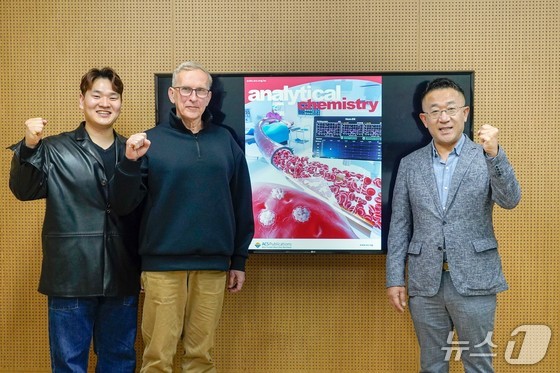
A South Korean research team has developed a technology capable of electrically measuring and precisely analyzing genetic characteristics of blood components in real-time, allowing for highly accurate blood test results.
Gwangju Institute of Science and Technology (GIST) announced on Friday that a research team led by Professor Yang Sung from the Department of Mechanical Engineering and Robotics has developed a new sensor technology capable of analyzing red blood cell alignment and the hydration structure of hemoglobin inside red blood cells under blood flow conditions.
This technology combines Electrochemical Impedance Spectroscopy (EIS) with microfluidic technology to precisely measure the alignment direction of red blood cells and the internal water structure of the cells while the blood is flowing, rather than in a stationary state.
Traditional blood component analysis methods typically involve testing stationary blood samples, which can lead to issues such as red blood cell aggregation or sedimentation, resulting in reduced measurement accuracy.
To address these challenges, the research team measured blood impedance in a microfluidic channel that simulates actual blood flow environments and analyzed the results using effective medium theory, which reflects anisotropic dielectric properties.
Notably, the team introduced a preferred alignment index to quantify red blood cell arrangement, revealing that approximately 34% of red blood cells align in the flow direction while the remaining 66% are randomly oriented.
Furthermore, the researchers modeled the inside of red blood cells not as simple solutions but as hemoglobin colloids with dual hydration shells, allowing for a more precise EIS analysis that considers the physical properties inside the cells.
Through theory-based analysis, the team successfully derived six major hematological indicators critical for accurately assessing red blood cell condition and functionality in actual blood: red blood cell count, hemoglobin concentration, hematocrit, mean corpuscular volume (MCV), mean corpuscular hemoglobin (MCH), and mean corpuscular hemoglobin concentration (MCHC).
When compared with clinical blood test results, the calculated values demonstrated an error margin of less than 3.5%, proving the method’s high accuracy and reliability.
Professor Yang emphasized that this study is highly significant as it goes beyond simply measuring impedance in flowing blood to provide a quantitative analysis of red blood cell alignment characteristics and hemoglobin hydration structure. He expressed expectations that the technology could be widely applied in various medical fields, such as smart healthcare devices and real-time hospital blood analyzers.
The research, conducted under the supervision of Professor Yang, with Research Professor Zhbanov Alexander and integrated master’s and doctoral program student Lee Ye Sung as co-first authors, was published as a cover paper in the prestigious international journal Analytical Chemistry on January 25.