The Korea Advanced Institute of Science and Technology (KAIST) announced on Monday that a research team led by Professor Lee Jeong Ho has made a groundbreaking discovery. They have identified the precancerous cells responsible for the development and treatment resistance of glioblastoma, a malignant brain tumor.
Glioblastoma is a malignant brain tumor with an alarmingly high recurrence rate within a year, even after standard treatments including extensive brain surgery.
In glioblastoma, the presence of cancer cells in various forms, each responding differently to treatment, is considered the biggest hurdle in effective therapy. This phenomenon is known as intratumoral heterogeneity.
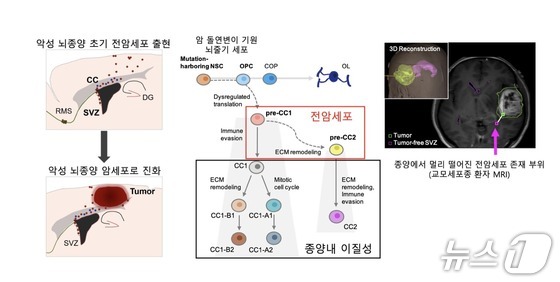
The research team uncovered that the root of this heterogeneity lies in precancerous cells. They demonstrated that these cells are the key drivers of tumor evolution and recurrence.
Using animal experiments with naturally occurring glioblastomas induced by somatic mutations, the team tracked precancerous cells at a single-cell level.
Their findings revealed that precancerous cells originate from a lineage of oligodendrocyte precursor cells. These cells acquire various tumorigenic transcription programs, ultimately differentiating into cancer cells with diverse properties.
The team also found similar precancerous cells in the subventricular regions of glioblastoma patients, confirming their role in tumor origin and the formation of intratumoral heterogeneity.
A researcher from the team explained that precancerous cells act as seeds of cancer heterogeneity, driving tumors to evolve into more complex and aggressive forms, and emphasized that understanding and targeting these cells is crucial for fundamentally overcoming glioblastoma.
This groundbreaking research has been published in the prestigious cancer journal, Cancer Discovery.