

On Tuesday, Korea Advanced Institute of Science and Technology (KAIST) announced a breakthrough in depression research. A team led by Chair Professor Heo Won-do from the Department of Life Sciences has developed an artificial intelligence (AI) technology that can analyze daily behavior patterns in animal models and detect depression symptoms based on gender and severity.
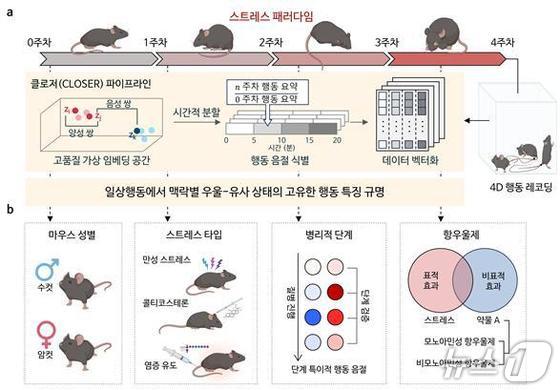
The researchers focused on the distinct physical movement patterns of depression patients, including limb movements, postures, and facial expressions. To precisely capture psychomotor activity—how emotional and mental states manifest in motor skills—the team created an AI platform called CLOSER. This innovative tool analyzes threee dimensional (3D) postures and movements of experimental animals, automatically detecting subtle behavioral changes associated with depression.
CLOSER utilizes a contrastive learning algorithm to break down behaviors into minute units for analysis. This approach allows the AI to discern even the slightest behavioral changes that would be imperceptible to the human eye.
The team tested CLOSER on a chronic unpredictable stress (CUS) mouse model, which closely mimics depression in humans. The results were impressive: CLOSER accurately differentiated depressive states based on gender and symptom severity.
Post-analysis revealed that stress primarily affects behavior frequency and flow rather than motor ability itself.
Gender differences in stress-induced behavioral changes were striking. Male mice exhibited decreased exploratory and turning behaviors, while female mice showed an increase in these activities. These behavioral shifts became more pronounced with prolonged stress exposure.
To further validate their findings, the researchers analyzed inflammation-based and stress hormone-based depression models.
The results were telling: continuous stress or inflammation led to noticeable changes in daily behavior, while administering only the stress hormone corticosterone resulted in minimal behavioral changes. This suggests that observing everyday behaviors could potentially distinguish between different causes of depression and gender-based variations.
In a groundbreaking discovery, the team identified a behavioral fingerprint that could help determine suitable antidepressants for patients based solely on their behaviors, opening doors for personalized treatment options.
Professor Heo emphasized the significance of this research, stating that they’ve pioneered the world’s first preclinical framework for personalized diagnosis and treatment evaluation of depressive disorders using AI-based daily behavior analysis. This breakthrough lays a crucial foundation for developing tailored treatments for mental health patients and advancing precision medicine.
The study, spearheaded by Ph.D. candidate Hyun-sik Oh from KAIST’s Department of Life Sciences, has been published in the prestigious journal Nature Communications.