

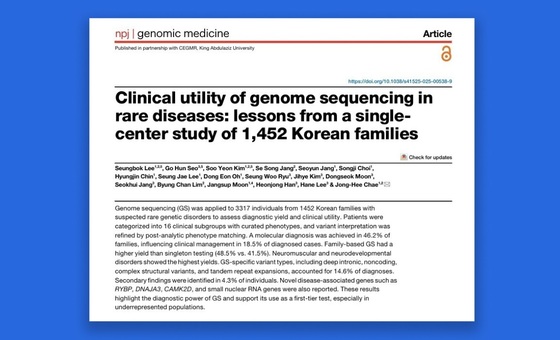
3Billion, an artificial intelligence (AI) powered rare genetic disorder diagnostics company, announced on Monday that their collaborative study with Seoul National University Hospital’s Rare Disease Center has been published in npj Genomic Medicine. This journal, part of the prestigious Nature portfolio, specializes in genomic medicine.
The study, the largest of its kind in South Korea, analyzed whole genome sequencing (WGS) data from 3,317 individuals across 1,452 families affected by rare diseases.
This publication follows 3Billion’s previous announcement of a 19,000-participant whole exome sequencing (WES) study, further solidifying their global reputation for precision in rare disease diagnostics.
Rare genetic disorders often lead patients on a prolonged diagnostic odyssey due to the complexity of identifying causative genes and the wide range of symptoms. To address this, the research team employed comprehensive WGS on patients who remained undiagnosed by conventional methods, aiming to validate its diagnostic efficacy and clinical applicability.
The study’s findings were impressive: WGS successfully identified the underlying cause in 46.2% of patients, with particularly high success rates in neuromuscular (62.4%) and neurodevelopmental disorders (49.2%). These results statistically confirm WGS’s superior clinical value in rare genetic disorder diagnosis compared to traditional methods.
Notably, 14.6% of diagnoses involved complex variants – deep intronic, non-coding region, or structural – that are typically challenging to detect with standard tests. 3Billion’s AI-driven variant interpretation technology played a crucial role in analyzing these complex cases, significantly enhancing the team’s diagnostic capabilities.
The study also demonstrated substantial clinical utility. Approximately 18.5% of diagnosed patients saw tangible benefits, including tailored medication and treatment strategies, elimination of unnecessary further testing, and genetic counseling for family planning.
Moreover, the research generated valuable genomic interpretation data specific to the Korean population, reducing dependence on international datasets and providing a foundation for developing localized precision medicine guidelines.
Professor Chae Jong-hee of Seoul National University Hospital, the study’s lead researcher, emphasized that this landmark study validates the clinical significance of genomic analysis in a large Korean rare disease cohort. It provides crucial evidence for integrating rare disease diagnostics into standard healthcare and represents a pivotal milestone in rare disease research.
Dr. Seo Go-hun, Chief Medical Officer at 3Billion, stated that the research demonstrates how combining real-world clinical data with AI-powered genomic interpretation can dramatically improve rare disease diagnostic accuracy and efficiency. It is committed to ongoing collaboration with healthcare professionals to refine the genomic interpretation technology for immediate clinical application.