

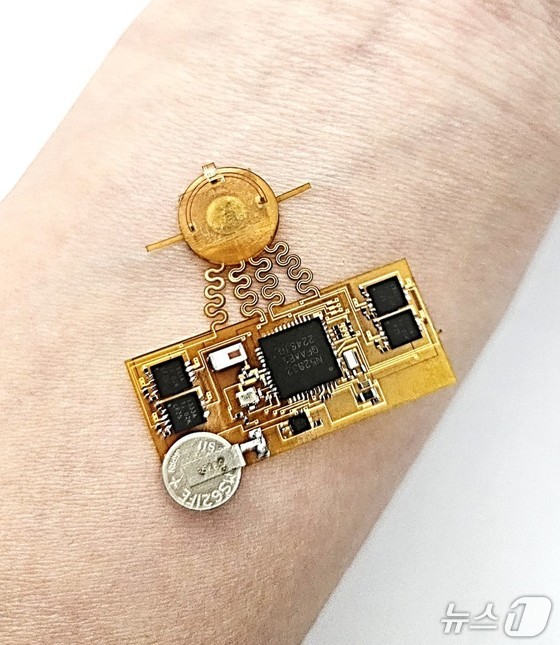
The Korea Advanced Institute of Science and Technology (KAIST) announced on Thursday that a research team led by Professor Kwon Kyung-ha from the School of Electrical Engineering has developed a groundbreaking wireless wearable blood flow measurement system. This innovative device combines deep learning with multilayer thermal sensing technology.
The system can simultaneously measure blood flow velocity and vascular depth non-invasively, without direct contact with blood vessels. Sensor signals fluctuate based on the depth of blood vessels beneath the skin, making depth information crucial for accurate blood flow calculations. Traditional methods using ultrasound or optical techniques had limitations, such as bulky equipment or accuracy issues depending on vascular depth.
To overcome these challenges, the team focused on the principle that blood flow creates subtle thermal movements in surrounding tissues. They developed a multilayer thermal sensing technology, strategically placing temperature sensors at various depths to create a three-dimensional analysis of heat transfer pathways. By integrating artificial intelligence (AI) algorithms, they successfully isolated and extracted vascular depth and actual blood flow velocity in real-time from complex body temperature distributions.
The AI application enabled precise differentiation between vascular depth and actual blood flow velocity within these intricate temperature patterns.
In trials, the system achieved remarkable precision, measuring blood flow velocities from 1 to 10 mm per second with a margin of error of just 0.12 mm, and vascular depths of 1 to 2 mm with an error margin of only 0.07 mm. This level of accuracy, finer than a human hair, surpasses the capabilities of conventional wearable devices.
Notably, when integrated with photoplethysmography (PPG) sensors found in smartwatches, this technology can slash blood pressure measurement errors by up to 72.6%. This advancement suggests that smartwatch blood pressure readings could soon rival the accuracy of hospital equipment.
The electronic patch shows promise for use in emergency medical situations, enabling real-time monitoring of patient conditions. It also has potential applications in personalized health management for individuals with hypertension and diabetes, and in early detection of acute warning signs such as shock.
Professor Kwon emphasized that this technology represents a fundamental platform for more precise blood flow and pressure measurements. When integrated into smartwatches, it will significantly enhance everyday health monitoring capabilities.
The research, spearheaded by graduate student Shim Young-min as lead author, has been published in the prestigious journal Science Advances.
The study received backing from several institutions, including the Samsung Advanced Institute of Technology (SAIT), the National Research Foundation of Korea (NRF) through its program for excellent early-career researchers, the Leading Research Center for Regional Innovation, the BK21 FOUR program, and the Institute of Information and Communications Technology Planning and Evaluation (IITP) for the AI Semiconductor Graduate School.