

Curiosis, a cell imaging-based analysis technology firm, is drawing attention for its automated cell analysis platform that’s boosting efficiency in biomedical research.
The company’s solutions are seeing growing demand as they minimize errors common in manual analysis processes and save valuable research time.
Industry sources, including the Korea Medical Device Development Fund, report that Curiosis, established in 2015, has developed an innovative live cell imaging system that automates cell observation and analysis.
Founder and Chief Executive Officer (CEO) Yoon Ho-young, a mechanical engineering graduate from Hanyang University with master’s and doctoral degrees from Seoul National University, started his journey in lab automation by founding Cytoneous in 2013 after a postdoctoral stint at Harvard University. He later established Curiosis in 2015.
Curiosis is a key player in the bio-materials and components sector, providing automation equipment and parts crucial for drug development and cell therapy production. Their flagship product, the Cell Logger, enables real-time monitoring and analysis of cell cultivation within incubators. To date, over 420 units have been supplied to 29 countries worldwide.
The company’s competitive edge stems from its 100% in-house development of core components, including circuit boards, image sensors, and optomechatronics. This vertical integration allows Curiosis to serve as both a component supplier and a finished product manufacturer.
The COVID-19 pandemic has further bolstered Curiosis’s prospects by dramatically increasing demand for lab automation. As the need for mass production of biopharmaceuticals grows, the limitations of manual cell cultivation are driving a surge in automation requirements.
Recently, Curiosis has expanded its reach to include organoid-based drug development platforms and in-hospital automated diagnostics.
The company went public on KOSDAQ last November through a technology special listing. Its shares are currently trading around 70,000 KRW (about 47 USD), more than triple its initial offering price of 22,000 KRW (about 15 USD), indicating strong market confidence.
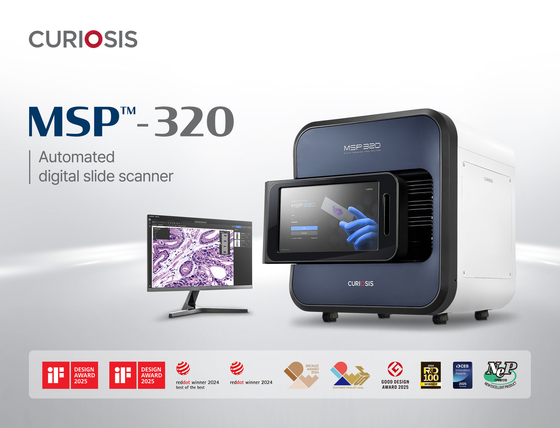
In 2024, Curiosis’s automated digital pathology device, the MSP 320, was selected as one of the top ten representative projects in the government’s comprehensive medical device research and development (R&D) initiative.
The MSP 320 not only rapidly captures high-resolution tissue slides for cancer diagnosis but also implements artificial intelligence (AI) based diagnostic screening, significantly advancing digital pathology technology in South Korea.
Prior to this recognition, Curiosis had already secured Class I medical device approval and earned New Excellent Product (NEP) certification from the Ministry of Trade, Industry, and Energy, officially validating its technological prowess. This government endorsement has strengthened its position for international market expansion.

Curiosis aims to turn a profit this year, potentially becoming the first company listed under technology special provisions to achieve annual profitability in the year following its initial public offering (IPO).
A Curiosis spokesperson stated that they’re committed to delivering cutting-edge technologies in the medical device sector to enhance patient care quality and improve healthcare operational efficiency. The goal is to become South Korea’s leading lab automation provider.