
A comprehensive study has uncovered that maternal smoking prior to childbirth can have lasting impacts on a child’s neurological development.
The research suggests that even a history of past smoking or relatively low tobacco consumption can increase the risk of neurological developmental issues in offspring.
On Tuesday, Professor Jang Mun-young and her team from the Department of Psychiatry at Korea University Guro Hospital released these findings. They analyzed data from 861,876 mother-child pairs born between 2009 and 2018 that met their study criteria.
The researchers categorized mothers based on smoking status using data from general health screenings conducted by the National Health Insurance Service within two years before childbirth. Mothers were classified as non-smokers, former smokers, or current smokers (at the time of examination). Children were followed until 2021, for an average of over eight years, to monitor for diagnoses of intellectual disabilities, autism spectrum disorder (ASD), and attention deficit hyperactivity disorder (ADHD).
The study revealed that children of mothers with any smoking history had significantly higher cumulative rates of all neurological developmental disorders compared to children of non-smoking mothers.
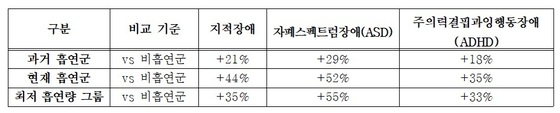
Children of former smokers showed a 21% higher rate of intellectual disabilities, a 29% higher rate of autism spectrum disorder, and an 18% higher rate of ADHD compared to children of non-smokers.
For children of current smokers, the rates were even more alarming: 44% higher for intellectual disabilities, 52% higher for autism spectrum disorder, and 35% higher for ADHD.
Further analysis of smoking intensity revealed that within the current smoking group, the risk of neurological developmental disorders increased proportionally with smoking amounts. Notably, even in the lowest smoking intensity group (less than 1.75 pack-years), the risk was elevated compared to children of non-smokers, with rates 35% higher for intellectual disabilities, 55% higher for autism spectrum disorder, and 33% higher for ADHD.
Professor Jang emphasized the significance of this study, stating that this research is groundbreaking as it confirms the link between maternal smoking and child neurological developmental disorders using the largest mother-child cohort in South Korea. She added that it underscores the critical importance of smoking cessation even before conception, as even a minimal history of past smoking can impact a child’s neurological development.
The findings of this study have been published in the latest issue of the prestigious international journal BMC Medicine.