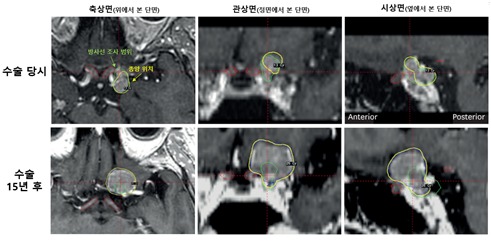
A new study has uncovered a concerning trend for patients with benign meningiomas near the optic nerve. Those who received lower radiation doses to protect their vision actually experienced worse outcomes in the long run, with tumors regrowing and significantly impacting both eyesight and survival rates.
Researchers from Seoul National University Hospital’s neurosurgery department, led by Drs. Baek Sun-ha and Lee Eun-jung, reported these findings on Wednesday. Their study followed 30 patients with optic nerve-adjacent benign meningiomas for over a decade after single-fraction Gamma Knife radiosurgery, with a median follow-up of 152 months.
These benign meningiomas develop within 2 mm of the optic nerve, typically arising in areas like the anterior clinoid process, sella turcica, optic nerve sheath, and cavernous sinus.
While stereotactic radiosurgery is an effective treatment, the tumor’s proximity to the optic nerve raised concerns about potential radiation-induced optic neuropathy.
To mitigate this risk, doctors often opted for conservative approaches, such as partial tumor irradiation or reduced radiation doses.
However, the long-term consequences of these cautious strategies remained unclear until now.
In the study cohort, the average tumor volume was 4.8 cm³, with a mean radiation dose of 12.7 Gy. Efforts to protect the optic nerve resulted in an average tumor coverage rate of just 76.7%.
Long-term follow-up revealed that while 90% of patients showed stable tumors at five years post-treatment, this rate dropped to 70% at ten years and 43% at fifteen years, indicating a progressive trend of tumor recurrence.
Given the slow-growing nature of meningiomas, the average time to recurrence was 107 months (about nine years), with a third of recurrences occurring more than a decade after initial treatment.
Crucially, the research team noted that most recurrences developed in areas intentionally undertreated to spare the optic nerve.
Surprisingly, no patients experienced vision loss due to radiation-induced optic neuropathy during the extended follow-up period.
However, two patients (9.1%) suffered vision deterioration when undertreated tumors regrew after 103 and 116 months, respectively, compressing the optic nerve. This reveals that attempts to avoid side effects ultimately led to tumor recurrence and vision loss.
Dr. Baek emphasized that the findings challenge the conventional wisdom of reducing radiation doses to minimize side effects. In fact, this approach may increase the risk of tumor recurrence and vision loss over time. Adequate tumor coverage and sufficient radiation dosage are critical for both tumor control and optic nerve protection.
Dr. Lee added that for large tumors abutting the optic nerve, fractionated radiosurgery offers a promising solution, potentially achieving both vision preservation and tumor control..
This groundbreaking research was published in the latest issue of the Journal of Korean Medical Science (JKMS).