


As National Aeronautics and Space Administration’s (NASA) Artemis 2 mission propels the Orion spacecraft into uncharted territories of space, it’s sparking renewed interest in the cosmic frontier. The healthcare sector, in particular, is eyeing the vast potential of space-based solutions.
In South Korea, Boryung is emerging as a trailblazer, spearheading initiatives in space infrastructure and cementing its position in this burgeoning market.
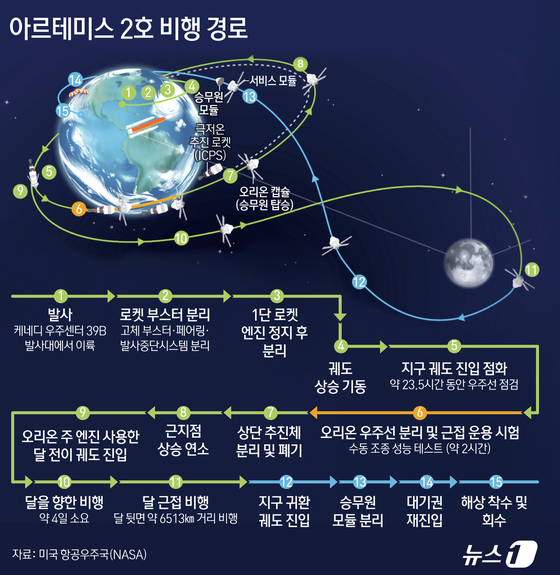
Industry reports from Wednesday reveal that Artemis 2 etched its name in the annals of space exploration just a day prior. At 2:56 a.m. (South Korean time), it soared past the 248,655-mile (about 400,000 km) mark from Earth, shattering the half-century-old record set by Apollo 13 in 1970.
As Artemis 2 ventured towards the far side of the Moon, it reached an unprecedented distance of 252,756 miles (about 406,771 km) from Earth by 8:02 a.m. This milestone surpassed Apollo 13’s record by roughly 6,700 km (about 4,163 miles).
The significance of this achievement extends far beyond mere record-breaking. It lays the groundwork for future lunar landings and deep-space human exploration, allowing NASA to test critical systems and operations essential for extended space travel.
This latest feat, coupled with South Korea’s successful fourth launch of its homegrown Nuri rocket late last year, is fueling excitement about the space industry’s potential. Many believe it’s on the cusp of a New Space era.
Space is no longer just a realm for exploration. It’s emerging as a cutting-edge laboratory for drug development, potentially revolutionizing the pharmaceutical industry.
Scientists are translating their research on how materials and organisms behave in zero gravity into groundbreaking industrial applications.
The Korean ARPA-H Project Greenlits Several Space Medicine R&D Initiatives
Global powerhouses like the U.S., Japan, and China are pouring resources into understanding how space environments affect human physiology. Pharmaceutical giants such as Merck, AstraZeneca, Eli Lilly, and Sanofi are also heavily invested in this frontier.
Merck’s Keytruda, based on pembrolizumab, is manufactured on the International Space Station (ISS). At roughly 700 million KRW (about 473,000 million USD) per 100 grams (about 3.52 oz), producing specialized cancer drugs by the kilogram in space remains profitable even after factoring in launch costs.
While South Korea has yet to establish clear objectives in space medicine, resulting in a piecemeal approach to technological advancement, Boryung is positioning itself at the forefront, expanding its portfolio with space-oriented ventures.
In a landmark move this April, Boryung inked a joint venture agreement with U.S.-based Axiom Space to collaborate on space initiatives.
The joint venture, with Boryung holding a 51% stake and Axiom Space 49%, will be based in South Korea. It aims to leverage Axiom Space’s expertise and infrastructure, focusing on projects related to the Axiom Station – the planned successor to the International Space Station (ISS).
Not to be outdone, Dong-A ST subsidiary Aptis is also venturing into space medicine research, seeking to carve out its niche in this emerging field.
The South Korean government, recognizing space as a key growth sector, is ramping up support. The Ministry of Health and Welfare, through its Korean ARPA-H project, has earmarked 108 hundred million KRW (about 7.3 million USD) for space medicine research at the Catholic Central Medical Center through 2029.
The medical community is abuzz with the possibilities of space medicine. Experiments that are challenging or impossible on Earth, such as three-dimensional (3D) stem cell cultivation and high-purity cancer drug synthesis, could unlock new frontiers in biomedical research.
An industry insider expressed optimism, noting that the unique microgravity environment of space opens up unprecedented opportunities for advanced biomedical research, including 3D stem cell cultures and high-purity cancer drug synthesis – feats that are extremely challenging to replicate on Earth.