

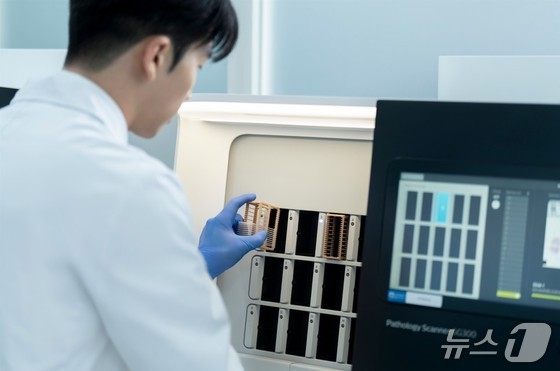
As medical technology advances rapidly, the precision of disease diagnosis has also improved, presenting a new paradigm that extends beyond early detection to the expansion of personalized treatment for patients. In particular, innovation through digital transformation is accelerating in the field of pathology diagnosis, a key component of early detection.
SCL (Seoul Clinical Laboratories), a diagnostic testing institution, said on the 16th it is advancing its internal systems by preparing to introduce artificial intelligence (AI)-based solutions based on its preemptively established digital pathology infrastructure. The company aims to lead the next-generation paradigm in pathology diagnosis.
Recently, digital pathology systems have been evolving by incorporating AI technology. AI-based image analysis solutions have improved the accuracy and reliability of interpretations by addressing limitations in traditional diagnostic processes such as lesion detection, classification and quantification.
In addition, cloud-based data storage and sharing systems are expanding applications in various fields, including remote diagnosis, multi-institutional collaboration and medical education, breaking down spatial constraints in pathology diagnosis.
Driven by technological innovation, the global digital pathology market is experiencing rapid growth. The market, valued at approximately $1.58 billion in 2023, is expected to grow at a compound annual growth rate of 18.63% to reach about $3.71 billion by 2028.
As adoption of digital pathology systems accelerates worldwide, SCL is continuing efforts to build a diagnostic infrastructure at a global level.
SCL introduced a digital pathology system in 2023 as the first diagnostic testing institution in Asia to do so. This has improved diagnostic accuracy and reduced the workload in the interpretation process, enhancing overall efficiency.
In particular, since adopting the digital pathology system, access to historical pathology data has improved. This data utilization capability serves as a key foundation for securing big data and developing pathology AI software in the future.
SCL is operating a digital collaborative diagnosis system and has received positive evaluations for improving clinical convenience by providing online slide review services to other medical institutions.
SCL plans to significantly strengthen advanced pathology analysis solutions using AI in the future. It is set to introduce an AI-based immunohistochemistry (IHC) analysis algorithm system in the second half of this year.
The solution, aimed at realizing precision medicine, analyzes whole slide images (WSI) to diagnose positive cells quickly and efficiently. Through precise analysis detecting all cells, it enhances interpretation accuracy and maximizes diagnostic efficiency by visualizing the distribution of positive cells.
Kwon Gui-young, head of the pathology department at SCL, said, “The digital pathology data accumulated by SCL will significantly contribute to advancing basic medical research, including new drug development and studies on disease mechanisms,” adding, “Based on an innovative pathology diagnosis paradigm, we will lead the era of patient-centered precision medicine and contribute to improving public health.”