The Korea Research Institute of Standards and Science (KRISS) unveiled on Tuesday a groundbreaking toxicity assessment system that automatically measures and analyzes water flea heartbeats.
Water fleas are prized in aquatic environmental toxicity assessments for their ease of cultivation, high reproducibility, and transparent bodies that facilitate long-term observation. Current international standard toxicity testing methods rely on visual observation of swimming inhibition, which can lead to subjective variability in results.
To address this limitation, researchers have turned to heart rate measurement as a quantitative indicator. However, accurately gauging the rapid heartbeat of water fleas, which occurs at about 6 to 8 beats per second, has proven challenging through visual observation alone.
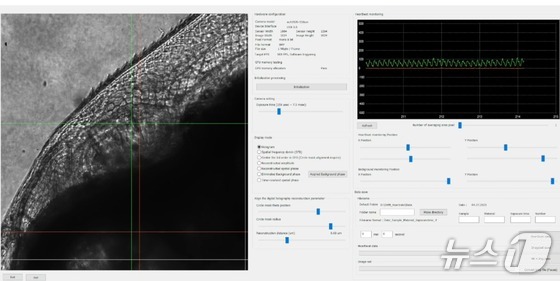
The KRISS team developed an innovative system to tackle this issue. It uses high-speed imaging to capture the heart region of water fleas fixed on fabric, recording light and dark pattern changes to automatically calculate heart rates. The system generates real-time measurement data, enabling subsequent analysis of toxic reactions.
Using this cutting-edge technology, researchers simultaneously analyzed heart rate changes in over 150 water fleas exposed to toxic substances. This mass analysis approach significantly enhanced the precision of their findings by revealing the distribution of individual responses.
The new system’s data distribution analysis can detect subtle differences between individuals and identify low-concentration, non-lethal toxicity that was previously difficult to confirm.
Its intuitive and user-friendly design allows for flexible application across various research environments and substances, offering high scalability. Experts anticipate its use in assessing risks from chemicals and nanomaterials in aquatic ecosystems like rivers and lakes.
This breakthrough is the result of collaboration between KRISS and the European Research Institute of the Korea Institute of Science and Technology (KIST). The KRISS-developed system has been installed at KIST’s European facility, where it’s being used for nanomaterial toxicity assessment experiments and data validation.
Dr. Kwon Ik-hwan, a senior researcher at KRISS, stated that it plans to enhance this system for applications beyond nanomaterial toxicity assessment, including human-like models such as cardiac organoids.
Lead researcher Dr. Lee Tae-geol announced plans to expand this technology globally through partnerships with domestic equipment manufacturers, aiming to reach cardiac toxicity research teams worldwide.
The study, funded by the Ministry of Science and Information and Communications Technology’s (ICT) infrastructure establishment project, has been published in the prestigious Journal of Hazardous Materials.