

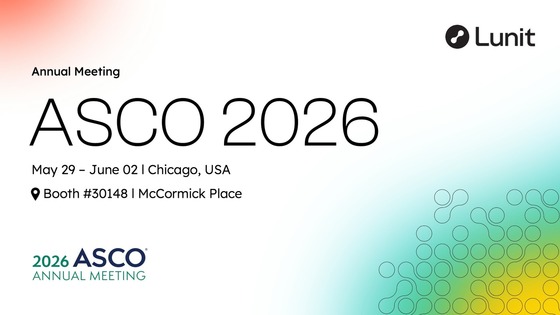
Medical artificial intelligence (AI) company Lunit said on April 22 it will present five research abstracts utilizing its AI biomarker platform, Lunit SCOPE, at the 2026 American Society of Clinical Oncology (ASCO 2026), to be held in Chicago at the end of next month.
A Phase 1b/2 clinical trial, led by Professor Lee Chung-geun of Yonsei University College of Medicine, evaluating first-line treatment for HER2-positive bile duct cancer patients using a combination of trastuzumab, nivolumab, and cytotoxic chemotherapy agents (gemcitabine and cisplatin), has been selected for a Rapid Oral Presentation.
Lunit participated in the study by providing analysis results from Lunit SCOPE.
In addition, four poster presentations will also be showcased: AI-based spatial analysis of endothelial cells and tumor-infiltrating lymphocytes (TILs) to predict response to Inlyta (axitinib) in adenoid cystic carcinoma; AI-based spatial analysis of the tumor microenvironment in microsatellite stable (MSS) metastatic colorectal cancer patients receiving immunotherapy; AI-based characterization of the tumor microenvironment in HER2-overexpressing non-small cell lung cancer; and a multi-omics post hoc analysis of a clinical trial confirming the potential to overcome immune resistance through TGF-β (transforming growth factor beta) inhibition in advanced gastric cancer.
Lunit CEO Brandon Suh said, “The selection of studies utilizing Lunit SCOPE across various cancer types, from bile duct cancer to lung, colorectal and gastric cancers, demonstrates that the application scope of AI biomarkers is rapidly expanding,” adding, “As more cases involve direct use in clinical trials, we will continue research and commercialization efforts to establish Lunit SCOPE as a key tool in treatment decision-making.”
Meanwhile, founded in 1964, the American Society of Clinical Oncology (ASCO) is recognized as one of the world’s three major cancer conferences, alongside the American Association for Cancer Research (AACR) and the European Society for Medical Oncology (ESMO). Each year, more than 40,000 medical professionals from more than 120 countries attend.
Lunit has participated in ASCO for eight consecutive years since 2019, presenting its latest research achievements related to AI biomarkers.