

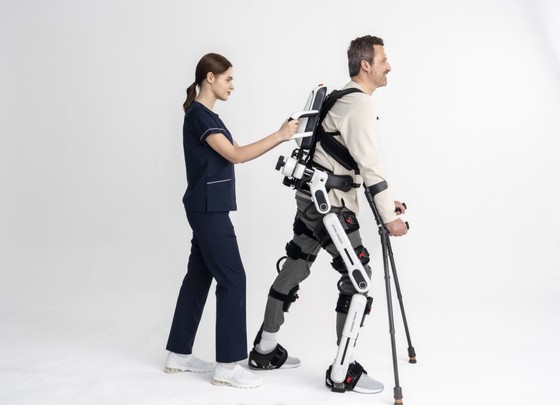
As aging drives a rapid increase in musculoskeletal disorders and mobility impairments, wearable robotics company Angel Robotics is expanding its presence by targeting both rehabilitation healthcare and industrial safety. Growing demand for robot-based assistive devices is also raising expectations for market growth.
According to industry sources on April 27, Angel Robotics was founded in 2017 by KAIST robotics professor Kong Kyeong-cheol and rehabilitation medicine specialist Dr. Na Dong-wook.
After winning a bronze medal at the first Cybathlon competition held in Switzerland in 2016, the founders established Angel Robotics and later competed in the second event in 2020, winning both gold and bronze medals, showcasing the global competitiveness of Korea’s wearable robotics technology.
Angel Robotics has built its technological edge around wearable robots designed to assist gait rehabilitation. Its core capability lies in analyzing users’ walking patterns and muscle strength to provide customized assistance.
The company has established a product portfolio centered on its flagship gait rehabilitation robot Angel Legs M20 and wearable assistive robot Angel Suit H10.
Angel Legs M20 is a hospital-use rehabilitation robot for patients with lower-limb paralysis, supporting both gait training and muscle recovery. Equipped with sensors at each joint, it detects users’ walking intentions and assists with flat-ground walking, stair climbing and squat exercises.
Angel Suit H10 targets more everyday applications. As a hip-joint assist wearable robot, it is designed to support walking for post-surgery rehabilitation patients and the elderly. It uses seven sensors and on-device artificial intelligence (AI) to analyze the wearer’s movements in real time.
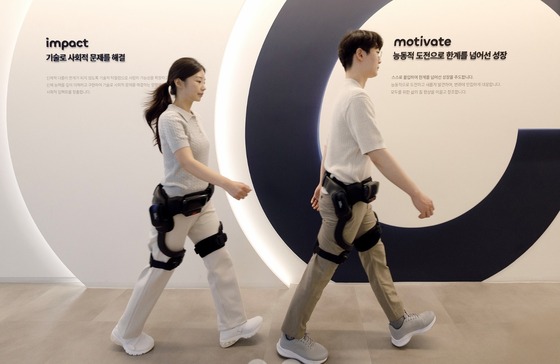
From gait rehabilitation to work assistance…building a full-cycle solution
Both products operate by guiding movement or supplementing muscle strength depending on the user’s condition, enabling precise and repetitive rehabilitation training. They are drawing attention in medical settings for their potential to reduce the burden of labor-intensive rehabilitation while improving treatment efficiency.
Due to their wearable nature, patients can continue using the devices after discharge, allowing continued gait assistance and potentially improving quality of life beyond treatment.
Industry observers expect Angel Robotics to expand beyond rehabilitation devices into broader “life care solutions.”
The company is also extending applications beyond healthcare into industrial settings. Wearable robots that reduce strain on workers’ lower back and lower body help prevent musculoskeletal disorders and improve work efficiency.
Their utility is particularly high in environments involving repetitive tasks or heavy lifting, and demand as industrial safety equipment is gradually increasing.
The company is also seeing positive momentum in adoption. Use of its products is expanding across hospitals and rehabilitation centers, while pilot applications in industrial sites are also increasing.
The market views wearable robots as a technology with strong potential to transform the paradigm of rehabilitation treatment.

However, challenges remain. Relatively high product prices are still cited as a barrier to broader adoption. The expansion of insurance coverage is also seen as a key factor for market growth. In addition, further accumulation of clinical data across diverse patient groups and validation of effectiveness are needed.
An industry official said, “Wearable robots will become an important tool to improve the efficiency of rehabilitation treatment and help patients return to daily life,” adding, “If Angel Robotics secures price competitiveness and institutional support follows, rapid market expansion will be possible.”