

On Wednesday, Albert Kim, Chief Executive Officer (CEO) of MSD Korea, announced at the Bio Korea 2026 event held at the Convention and Exhibition Center (COEX) in Seoul that Korea has become a crucial hub for MSD’s global innovation, spanning clinical collaborations, licensing agreements, and manufacturing partnerships.
Kim emphasized that Korean partners have progressed beyond merely participating in global programs to actively shaping their direction.
During the session on MSD’s Business Development and Licensing Strategy, Grace Han McMahon, Head of Business Development and Licensing for MSD Pacific, highlighted neuroscience as a key area of interest. She stressed the importance of technologies that can cross the blood-brain barrier (BBB) in treating neurodegenerative diseases like Alzheimer’s and Parkinson’s.
McMahon explained that MSD conducts joint research with external companies through clinical collaboration programs, validating drug candidates and gathering data. She also noted that venture investment is a critical strategy, with investments of up to 25 million USD in early-stage companies, some of which evolve into licensing agreements and partnerships.
She further elaborated that while MSD’s headquarters focuses on late-stage clinical assets, regional hubs are tasked with discovering early-stage technologies and managing open innovation. Korea, she added, is a significant innovation hub for the company.
Collaboration with Korea continues to yield results. McMahon pointed out that many Korean companies possess exceptional scientific capabilities, and MSD has expanded cooperation through various partnerships in fields such as antibody-drug conjugates (ADC), cardiovascular diseases, and infectious diseases.
Lee Hyun-Joo, Executive Director of Clinical Research at MSD Korea, presented on the company’s domestic clinical research innovation strategy, noting that Korea is establishing itself as a global clinical hub.
Lee reported that the number of clinical trial approvals in Korea surpassed 700 in 2025, indicating rapid growth in clinical research. She highlighted that MSD Korea has maintained a research-focused structure by investing over 70 billion KRW (approximately 47.1 million USD) annually in rsearch and development (R&D) for five consecutive years.
Global participation in clinical trials, particularly for cancer treatments, is robust. Korea ranks as a major clinical trial location after the U.S., China, and Japan based on patient participation, with domestic institutions holding a significant share within the global clinical network.
Collaboration with domestic pharmaceutical and biotech companies is also expanding. Currently, over 12 companies and more than 15 hospitals are engaged in joint research, fostering an open innovation ecosystem.
Lee outlined future strategies that include expanding early-stage collaborations, diversifying the portfolio, and strengthening patient-centered research. She emphasized that trust-based cooperation between researchers and regulatory agencies is crucial for success.
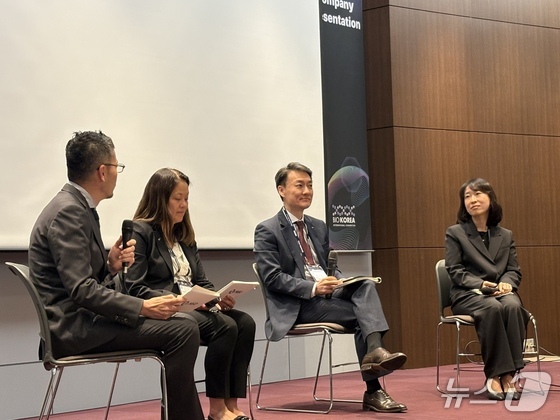
The subsequent panel discussion was moderated by Koji Yashiro, who oversees MSD Pacific’s business development and licensing for Korea and Japan. Participants included McMahon, Kim, and Lee, who explored MSD’s vision for future collaboration with Korea.