Medipost announced on Wednesday that its umbilical cord-derived allogeneic mesenchymal stem cell therapy, CARTISTEM®, has successfully met all primary and secondary efficacy endpoints in its Phase 3 clinical trial in Japan. The results confirmed significant improvements in clinical pain relief, functional recovery, and cartilage regeneration.
This breakthrough demonstrates Medipost’s global competitiveness in Japan, a country with one of the world’s highest proportions of elderly citizens aged 65 and above. The company is now poised to accelerate its application for product approval in the latter half of the year.
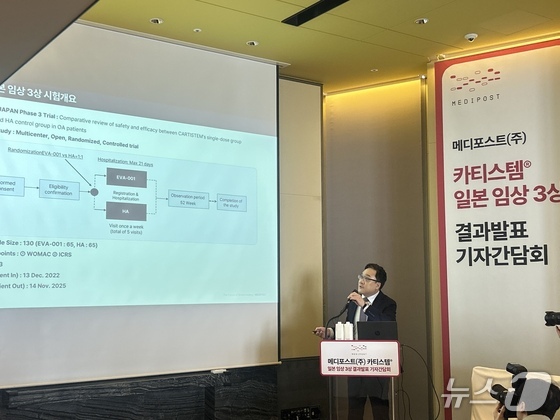
Medipost held a press conference at the Four Seasons Hotel in Seoul’s Jongno district to unveil the results of CARTISTEM’s Phase 3 clinical trial for knee osteoarthritis treatment in Japan.
Lee Seung-jin, Head of Global Business and Chief Executive Officer (CEO) of the Japanese subsidiary, reported that they’ve achieved clear statistical significance across all primary and secondary efficacy endpoints in the Japanese Phase 3 trial.
Lee added that the Japanese Phase 3 results reaffirm CARTISTEM’s exceptional efficacy and safety profile. The consistency observed across both primary endpoints and all secondary variables is particularly significant from a clinical perspective.
According to Lee, the Japanese Phase 3 trial demonstrated statistically significant results across all primary and secondary efficacy endpoints, marking a clinical success.
The Phase 3 trial in Japan involved 130 patients with moderate to severe knee osteoarthritis (Kellgren–Lawrence Grade 2-3) across 13 medical institutions. Participants were divided into two groups: 59 patients received CARTISTEM, while 61 received hyaluronic acid (HA) injections.
The trial was designed as an open-label, randomized study, using sodium hyaluronate (HA) injections as the control. Safety and efficacy were evaluated through a one-year (52-week) follow-up period after administration.
To ensure objectivity, the study employed a randomized design, evenly distributing demographic characteristics between the two groups.
The trial achieved a balanced distribution of key factors between the groups, including average patient age (61.3 years for CARTISTEM, 62.2 years for control), osteoarthritis severity indicators like Kellgren–Lawrence Grade, cartilage defect degree (ICRS), and baseline pain scores. This meticulous allocation enhanced the reliability of the clinical outcomes.
A notable aspect of the study design was the inclusion of two primary efficacy endpoints. These simultaneously assessed cartilage regeneration through arthroscopy and patient-reported outcomes (PROs) for pain and functional improvement one year post-CARTISTEM treatment.
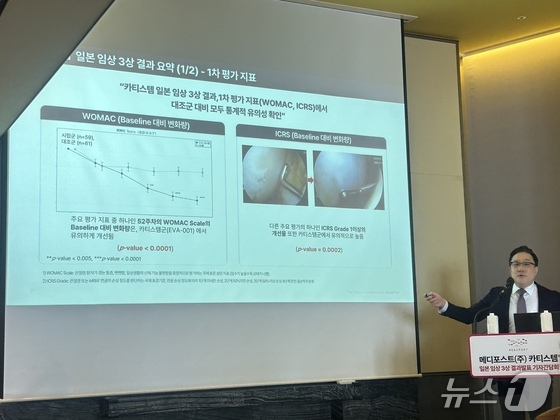
The clinical results revealed that CARTISTEM significantly outperformed the control group in both secondary evaluation indicators: improvements in knee pain and function (Western Ontario and McMaster Universities Arthritis Index (WOMAC) scores), and the rate of ICRS Grade 1 or higher improvement (WOMAC p-value <0.0001, ICRS p-value =0.0002).
Statistically significant improvements were observed in all secondary outcome measures. Significant improvements were seen in all key indicators, including the Visual Analog Scale (VAS) (p-value <0.0001), which measures pain intensity, and the International Knee Documentation Committee Subjective Knee Form (IKDC) (p-value <0.0001) and the Knee injury and Osteoarthritis Outcome Score (KOOS) (p-value <0.0001), which assess knee function. The WOMAC subscales (pain, function, stiffness; p-value <0.0001) also showed marked improvement. CARTISTEM also exhibited an excellent safety profile, with all serious adverse events (SAEs) during the trial determined to be unrelated to the treatment.
CARTISTEM Demonstrates Unparalleled Efficacy in Indicators Matching U.S. Phase 3 Trials
The fact that the drug demonstrated statistically highly significant superior efficacy compared to the active control group in the WOMAC (p-value <0.0001) and 100 mm VAS (p-value <0.0001)—which are the same primary endpoints as those in the ongoing U.S. Phase 3 clinical trial—is viewed as a positive sign for future global expansion.
Lee emphasized that the Japanese Phase 3 trial’s confirmation of CARTISTEM’s cartilage regeneration effect, previously established in Korean Phase 3 trials, solidifies its potential as a disease-modifying osteoarthritis drug (DMOAD). This positions CARTISTEM strongly for entry into the global market as a treatment that offers structural improvement.
Medipost aims to submit its application for Japanese product approval in the second half of this year, targeting approval by the end of 2027.
In December of last year, Medipost secured a pivotal license agreement with Teikoku Pharma for CARTISTEM’s exclusive sales rights in Japan, establishing a foundation for market entry. This deal is expected to yield substantial returns, including an upfront payment of 11.8 billion KRW (approximately 7.9 million USD) and a regulatory milestone of 14.8 billion KRW (approximately 9.9 million USD), based on last December’s exchange rates. Additional revenue streams are anticipated from long-term sales milestones and the supply of both raw materials and finished products.