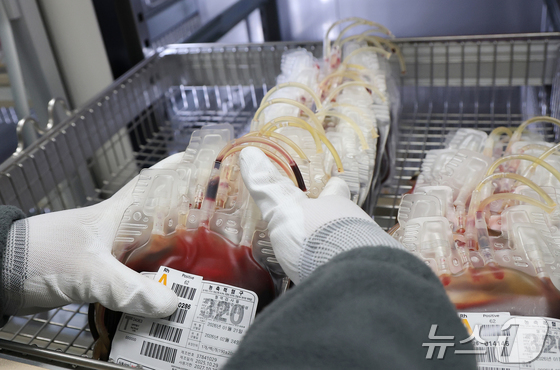
The government has initiated measures to ensure blood supply stability and promote a culture of blood donation, as participation from the key donor demographic of 10 to 29-year-olds declines due to low birth rates and an aging population. Plans include raising the eligible age for donors and revising criteria to expand the pool of potential blood donors. The government also aims to enhance recognition for donors and increase the deployment of mobile blood donation units.
On Wednesday, the Ministry of Health and Welfare finalized the second Basic Plan for Blood Management (2026-2030) after review by the Blood Management Committee. This follows the implementation of the first Basic Plan (2021-2025), which was established after the Blood Management Act was amended in December 2018.
National Blood Donation Rate at 5.6%: Not Alarming, But Stable Supply Management Crucial
As of 2024, the national blood donation rate stands at 5.6%, surpassing Japan’s 4% and France’s 3.9%. However, donors aged 10 to 29, who make up 55% of all donors, have decreased from 11.6 million in 2020 to 10.6 million in 2024 due to declining birth rates. Conversely, the over-50 population, which accounts for most transfusions, is growing due to aging. Red blood cell transfusions for those over 50 increased from 347,000 in 2020 to 366,000 in 2024, underscoring the importance of maintaining a stable blood supply.
The Ministry plans to raise the eligible donation age, considering the increasing health span of Koreans. The current eligible age for blood donation in Korea was last revised in 2010. Whole blood and plasma donations are permitted for ages 16 to 69 (with restrictions for those over 65), while platelet donations are allowed for ages 17 to 59.
Compared to countries like the U.S. (which has no age limit) and Australia (which allows donations up to age 75), Korea’s age limit is relatively low. The Ministry is exploring the possibility of raising the donation age by about five years, pending further research. Discussions are set to conclude by year-end, with implementation planned for next year.
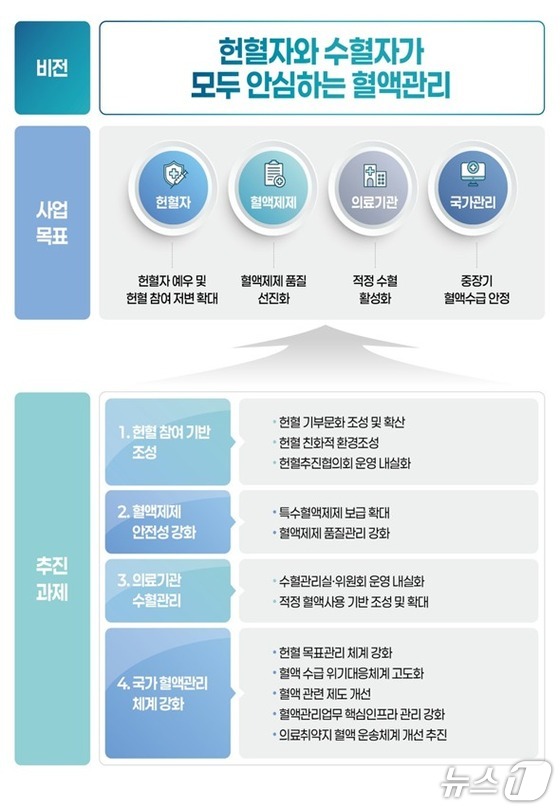
The government will also eliminate the liver function test (ALT test), identified as an unnecessary step in blood donation, and reassess malaria testing procedures that currently restrict donations. These changes aim to increase the donor population. Regular mobile blood donation units will operate in areas without permanent donation centers, and the operating hours of existing centers will be made more flexible.
To attract younger donors, the Ministry plans to offer incentives such as subscriptions to streaming platforms like Netflix and exclusive collectible items only available through blood donation. The Korean Red Cross, which manages the national blood program, recently partnered with a popular idol group for a promotional event.
Upgrading Aging Blood Center Facilities and Promoting Appropriate Blood Use in Hospitals
To reduce adverse immune reactions, the Ministry plans to increase the supply of leukocyte-reduced red blood cell and platelet products, as well as irradiated blood products. Korea currently experiences a higher rate of febrile non-hemolytic transfusion reactions compared to other countries, and this initiative aims to minimize such occurrences.
To maintain the accuracy of blood testing, the Ministry will replace outdated equipment promptly and continue projects to upgrade aging facilities. They have already invested 22.3 billion KRW (about 14.9 million USD) in new testing equipment and plan to allocate about 4 billion KRW (about 2.7 million USD) annually for ongoing improvements.
To ensure appropriate blood distribution to medical facilities, the Ministry will establish supply criteria based on each institution’s inventory levels. They will pilot this system in hospitals with high blood usage but stable inventory before expanding it nationwide.
Additionally, the Ministry will incorporate blood transfusion appropriateness assessments into quality evaluation metrics for general hospitals to promote proper use of transfusions. They will expand training for transfusion management staff and publish operational guidelines for these departments.
The Ministry is also exploring the use of postal services to transport blood to medical facilities in underserved areas. Currently, 80% of medical institutions receive blood directly from supply vehicles, but this new plan could reduce transportation costs for private healthcare providers.
Recent declines in the use of blood donation certificates and the blood donation refund accumulation system, which compensates for transfusion costs, will also be addressed. The use of blood donation certificates has decreased, leading to an increase in the refund accumulation fund from 49.1 billion KRW (about 32.9 million USD) in 2019 to 61.5 billion KRW (about 41.2 million USD) last year. The Ministry aims to enhance donor recognition and pride while preserving the spirit of voluntary donation.
Health and Welfare Minister Jeong Eun-kyung stated that the commitment of blood donors to saving lives serves as a cornerstone for stable blood supply and patient care. She added that the government will continue its efforts to expand blood donation participation and ensure that Koreans can receive transfusions with confidence.