Researchers at the Korea Institute of Science and Technology’s (KIST) Gangneung branch have developed a groundbreaking technology for producing customized medical food using three dimensional (3D) printing techniques. This innovation is specifically designed to aid patients with dysphagia, a condition that causes difficulty in swallowing.
Dr. Song-Yi Gu and her team from the Natural Product Systems Biology Research Center at KIST’s Natural Products Research Institute announced on Wednesday that they have successfully created a composite ink for 3D printing. This ink combines high-protein microalgae, known as Golden Chlorella, with natural starch.
The core of this technology lies in its ability to precisely adjust the viscosity and texture of food to match the swallowing capabilities of patients, particularly those with pancreatic cancer and the elderly suffering from dysphagia.
The research team explained that they utilized various starches, including corn, potato, and tapioca, to maintain the food’s shape during the 3D printing process while achieving the desired consistency and elasticity for easy swallowing. They have also compiled data on the physical property changes of different starch types, establishing guidelines for customized texture control based on the severity of dysphagia.
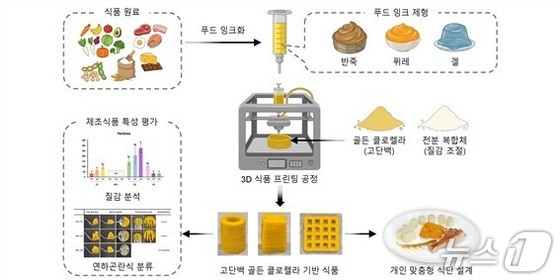
Unlike traditional liquid diets that often fail to preserve the original form and texture of food, this new technology can replicate both the shape and texture of meals. This innovation not only enhances the eating experience but also boosts patients’ psychological well-being during mealtimes.
The team also noted that their technology allows for the production of customized dysphagia diets that align with the International Dysphagia Diet Standardisation Initiative (IDDSI) guidelines.
Dr. Song-Yi Gu, a senior researcher at KIST, hailed this development as a revolutionary achievement that addresses the daily mealtime challenges faced by patients through advanced technology. She expressed hope that by incorporating functional natural materials, they could significantly improve the quality of life for cancer patients and the elderly.
Looking ahead, the research team plans to expand their studies on customized medical foods. They aim to cater not only to cancer patients but also to the elderly and those with chronic diseases by incorporating a wider range of functional natural materials.
This research was supported by the Ministry of Science and Information and Communications Technology (ICT) and the Ministry of Agriculture, Food and Rural Affairs. The findings have been published in the latest issue of the prestigious international journal Food Hydrocolloids.