

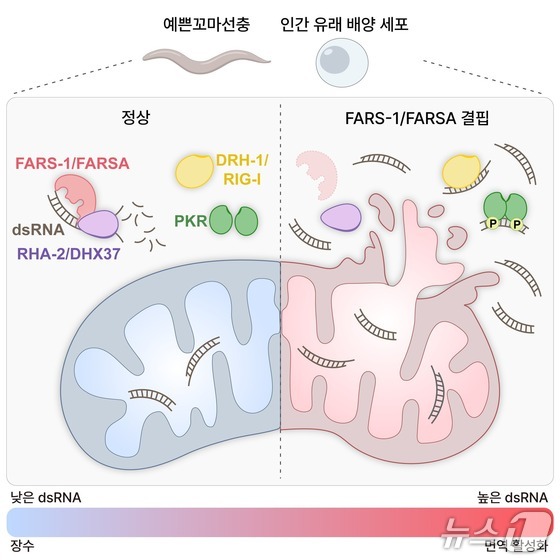
A South Korean research team has uncovered the cause of aging related to the accumulation of double-stranded RNA (dsRNA), a hidden immune signal within cells. This discovery is expected to lay the groundwork for extending healthy lifespans and provide valuable baseline data for developing practical strategies in the era of precision medicine that can self-regulate the pace of aging.
On Tuesday, the Korea Research Foundation announced that a research team led by Professors Lee Seung-jae and Kim Yoo-sik from the Korea Advanced Institute of Science and Technology (KAIST) has identified the molecular mechanism by which the protein FARSA regulates the homeostasis of intracellular double-stranded RNA and how immune overactivation caused by dsRNA accumulation promotes aging.
Aging is not simply a physical change that occurs over time; it’s a phenomenon that accelerates when the delicate balance within cells is disrupted.
Recently, the scientific community has been focusing on RNA homeostasis collapse, where RNA within cells fails to maintain a stable state, as one of the key drivers of aging. Notably, double-stranded RNA, which typically triggers immune responses during viral infections, is also naturally produced in our bodies. However, how it contributes to aging in the absence of external infections has remained a mystery until now.
The research team discovered that as individuals age, double-stranded RNA gradually accumulates within cells, closely correlating with shortened lifespan. Analysis revealed that the FARSA protein, previously known only for its role in protein synthesis, performs a new function in regulating double-stranded RNA.
Using artificial intelligence (AI) based protein structure prediction technology, the research team suggested that FARSA may possess a unique structure allowing it to bind to double-stranded RNA. FARSA plays a crucial role in suppressing excessive accumulation of mitochondria-derived double-stranded RNA, thereby slowing the progression of cellular aging.
Specifically, they demonstrated that FARSA collaborates with enzymes that unwind RNA structures to manage them, and when this system malfunctions, it leads to abnormal activation of the immune response, accelerating the aging process.
Professor Lee stated that this study is significant in that it reveals the specific pathway through which the accumulation of intracellular double-stranded RNA induces immune overactivation and promotes aging. By discovering this new function of the FARSA protein, it hopes to contribute to identifying the causes of aging-related diseases and developing therapeutic strategies to regulate them.
The research team plans to continue studying regulatory strategies targeting FARSA to ensure they can be safely and effectively applied in clinical settings.
This research was supported by the Ministry of Science and Information and Communications Technology (ICT) and the Korea Research Foundation as part of the Leading Research Project and the Bio-Medical Technology Development Project (Next-Generation RNA Editing Technology Project). The findings were published online in the international life sciences journal Molecular Cell.