
“K-beauty’s next competitive edge will come from convergence with industries such as biotechnology, medical devices and fashion.”
That is the vision of Hwang Sung-eun, director of the Medical Device and Cosmetics Industry Division at the Korea Health Industry Development Institute (KHIDI).
Speaking with News1 in San Diego, where BIO USA 2026 was recently held, Hwang said K-beauty’s next growth strategy should focus on integrating with other industries.
As K-beauty has gained greater recognition in the U.S. and global markets, the industry should now combine functional cosmetics with biotechnology, medical devices and fashion to build a sustainable foundation for future growth, he said.
KHIDI recently hosted a themed pop-up store, “K-Beauty ON: Lab to Skin,” in San Diego during BIO USA 2026, operating the showcase for three days.
The event highlighted the convergence of biotechnology and K-beauty to global industry stakeholders, with 10 Korean small and medium-sized companies participating, including Lanique, Pharmology and Stigma Bio.
During the event, participating company Beacon signed a memorandum of understanding (MOU) with U.S. buyer Link One to cooperate on distribution and supply in the U.S. market.
The agreement is expected to generate exports worth about $2 million.
Hwang said K-beauty companies have traditionally expanded overseas through cosmetics exhibitions and trade shows but added that it is now time to pursue new opportunities by connecting with the biotechnology industry.
“Pharmaceutical and biotechnology ingredients and technologies are increasingly being incorporated into cosmetics,” he said. “Building an ecosystem where biotech and cosmetics grow together will become the industry’s competitive advantage.”
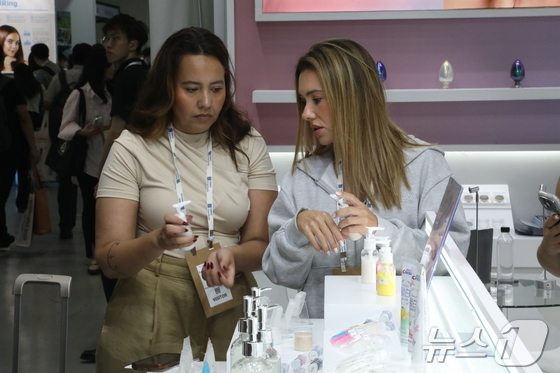
Visitors browse exhibition booths at In-Cosmetics Korea, a cosmetics ingredients and materials trade show held at South Korea on July 1. The exhibition runs through July 3.
Hwang also noted that Korea has a well-integrated value chain connecting brand owners, original development manufacturers (ODMs), ingredient suppliers and distributors.
“That structure allows companies to respond quickly to emerging trends and rapidly bring products to global markets, which differentiates Korea from other countries,” he said.
KHIDI is also reshaping its overseas support strategy this year by expanding its presence in the U.S. and Europe while building platforms to help Korean small and medium-sized cosmetics companies enter global markets more effectively.
One flagship project is a dedicated K-beauty showroom in Los Angeles, where KHIDI plans to invest about $4.7 million to establish a permanent exhibition space at the California Market Center (CMC) exclusively for Korean cosmetics companies. Operations are scheduled to begin in September.
“The U.S. became Korea’s largest cosmetics export market last year,” Hwang said. “This will be more than a display space. It will serve as a platform connecting local buyers, influencers and distributors.”
KHIDI is also strengthening its European strategy. After establishing a regional office in Paris this year, the institute plans to host a K-beauty pop-up event during Milan Fashion Week in September.
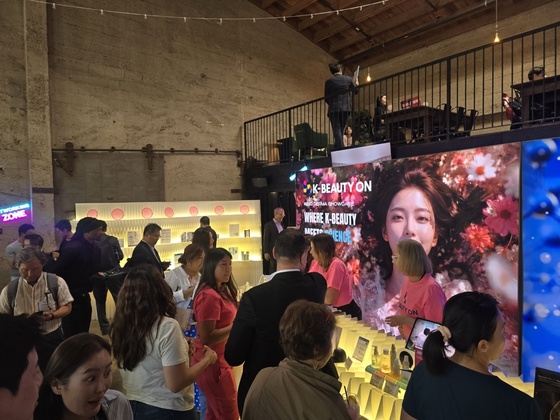
A Lab to Skin pop-up store hosted by the Korea Health Industry Development Institute during BIO USA 2026 in San Diego in late June. (KHIDI)
KHIDI also sees strong potential in combining functional cosmetics with medical devices, viewing the two sectors as complementary rather than separate industries.
“Services that combine skin diagnostic devices or aesthetic medical equipment with cosmetics are expanding rapidly overseas,” Hwang said. “One representative model diagnoses a person’s skin condition and then recommends suitable skincare products. From a healthcare industry perspective, this type of convergence deserves active support.”
He cautioned, however, that brand recognition alone will not be enough to sustain growth.
“Going forward, it will become increasingly important to validate products’ efficacy and safety with objective evidence,” Hwang said. “The government also plans to expand support to help companies generate reliable validation data.”
He added that success in the U.S. market could naturally lead to expansion into Europe, Latin America and other regions.
“As K-beauty converges with biotechnology, fashion and other industries, we expect its global competitiveness to become even stronger.”