

The brain produces approximately 500 mL (about 16.9 oz) of cerebrospinal fluid daily to cleanse itself. This fluid carries away waste generated in the brain, but for years, scientists were puzzled about exactly where it escapes from the protective membranes surrounding the brain.
A South Korean research team has made a groundbreaking discovery of microscopic openings inside the skull, where the brain and nose are in close proximity, that allow cerebrospinal fluid to pass through. These hidden drains are located in the arachnoid membrane surrounding the olfactory bulb, the region of the brain responsible for processing smell.
While previous research had established that cerebrospinal fluid drains through lymphatic vessels near the nose to the neck lymph nodes, the specific route through which this fluid traverses the arachnoid membrane into the meningeal lymphatic vessels remained a mystery. This study fills that crucial gap in our understanding.
On Wednesday, the Ministry of Science and Information and Communications Technology (ICT) announced that a research team led by Dr. Ko Kyu-Young from the Institute for Basic Science’s (IBS) Vascular Research Center has identified tiny openings in the arachnoid membrane that allow cerebrospinal fluid to pass through. The findings were published in the prestigious scientific journal Cell.
Hidden Drain Between Brain and Nose: First Confirmation of Membrane Passage Pathway
Cerebrospinal fluid is a clear liquid that circulates around the brain and spinal cord. It serves a dual purpose: protecting the brain from external impacts and acting as a cleaning agent that flushes out waste products from the brain.
If this drainage function deteriorates, harmful proteins such as amyloid beta, associated with Alzheimer’s disease, can accumulate in the brain. While studies have demonstrated a link between cerebrospinal fluid drainage disorders and cognitive decline or neurodegenerative diseases, the exact pathway through which it exits the protective membranes remained elusive until now.
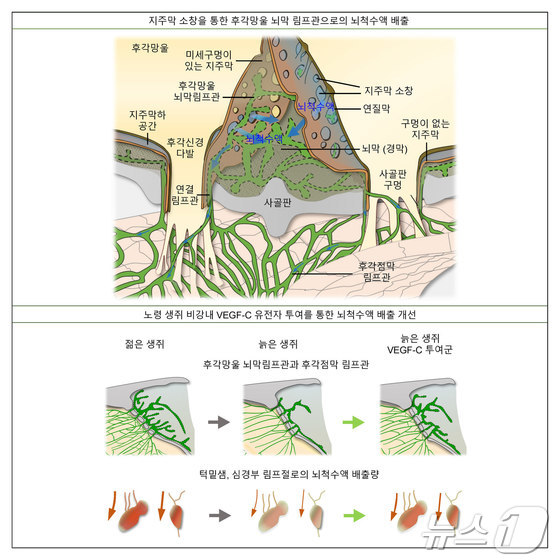
The brain’s protective coverings consist of multiple layers. Cerebrospinal fluid flows through the space between the brain and the middle protective layer, known as the arachnoid membrane. To reach the lymphatic vessels in the outer meningeal layer, it must pass through this membrane.
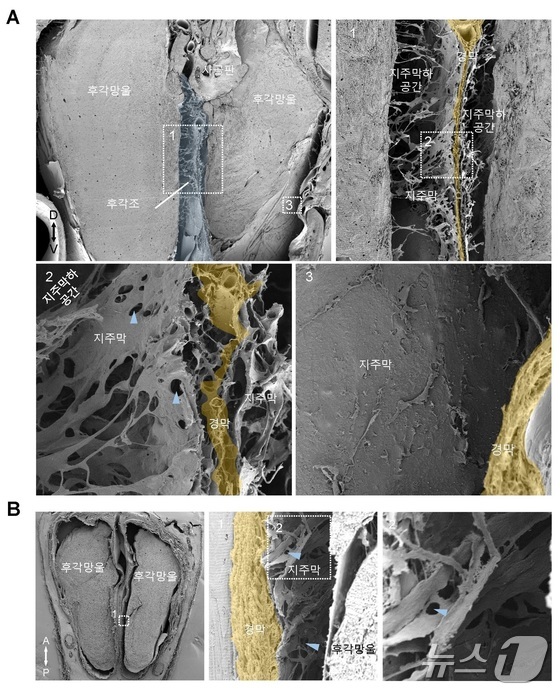
The research team examined the area surrounding the olfactory bulb and discovered clusters of tiny openings in the arachnoid membrane, averaging 4.5 micrometers (μm) in diameter. To put this in perspective, these openings are about one-twentieth the thickness of a human hair.
It’s important to note that these openings are not located inside the nose itself, but rather within the skull near the olfactory bulb, where the brain and nose are in close proximity. In layman’s terms, these minuscule drains allow cerebrospinal fluid to escape through the arachnoid membrane into the outer meningeal layer.
After passing through these arachnoid openings, the cerebrospinal fluid enters the lymphatic vessels in the meninges. From there, it travels through lymphatic vessels inside the nose to the lymph nodes in the neck. This network functions similarly to a drainage system that carries bodily fluids and waste.
The research team confirmed this pathway by introducing fluorescent markers into the cerebrospinal fluid. These markers were observed exiting through the arachnoid openings and traveling through the meningeal lymphatic vessels and nasal lymphatic vessels to the neck lymph nodes. Notably, similar openings were also identified in primates.
While previous research had established that cerebrospinal fluid drains around the nose, the exact mechanism of its passage through the arachnoid membrane into the meningeal lymphatic vessels remained unclear. This study provides the first concrete evidence that cerebrospinal fluid exits through these newly discovered openings in the arachnoid membrane surrounding the olfactory bulb.
Aging Reduces Opening Number and Size By 50-60%, Decreasing Drainage Volume
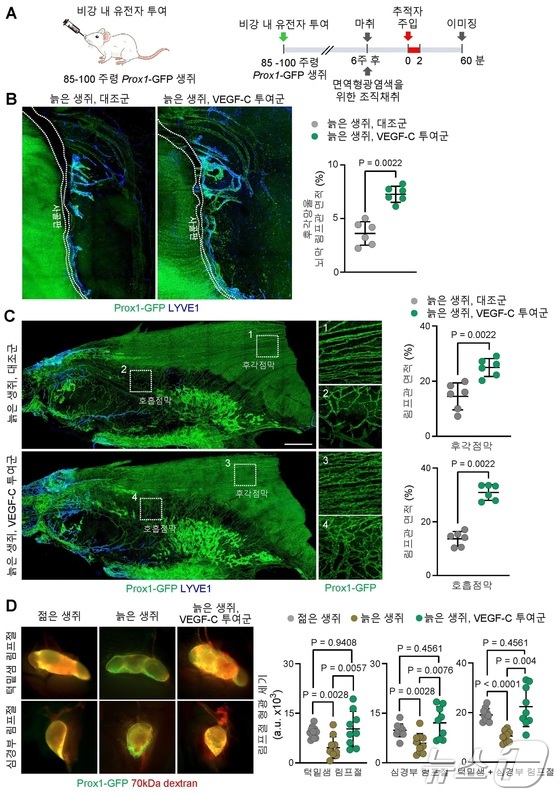
The efficiency of these drainage pathways appears to decline with age. In older mice, both the size and number of openings in the arachnoid membrane decreased by 50-60% compared to younger mice. The surrounding lymphatic vessels also showed a reduction. As a result, the volume of cerebrospinal fluid draining to the neck lymph nodes decreased significantly.
When the number and size of these arachnoid openings diminish, cerebrospinal fluid may not drain effectively, increasing the risk of waste accumulation in the brain. The research team suggests that these age-related changes could provide valuable insights into cognitive decline and neurodegenerative diseases associated with aging.
In a promising development, the research team administered the VEGF-C gene, which promotes lymphatic vessel formation, into the noses of older mice. This intervention led to a two- to three-fold increase in lymphatic vessels around the olfactory bulb and nose. Moreover, the previously reduced cerebrospinal fluid drainage was restored to levels comparable to those of younger mice.
These findings suggest the potential to rejuvenate the weakened cerebrospinal fluid drainage function in aging brains by delivering factors that promote lymphatic vessel formation through the nose. This breakthrough could pave the way for novel treatment approaches targeting the arachnoid openings or surrounding lymphatic vessels.
However, it’s crucial to note that these results don’t imply an immediate nasal treatment for preventing or treating dementia. The study confirmed improved cerebrospinal fluid drainage in older mice, but further research is needed to determine if this can effectively prevent amyloid beta accumulation, cognitive decline, or dementia progression in humans.
It remains to be seen whether the same structures and therapeutic effects occur in humans. While the research team identified similar structures to the arachnoid openings in primates, extensive studies on human tissue and rigorous safety assessments are necessary before any clinical applications can be considered.
Dr. Ko emphasized the significance of their findings, stating that by confirming the same arachnoid opening structure in primates, it has uncovered key evidence to elucidate the brain’s cleaning mechanism in humans. It plans to expand the research using human tissues and develop innovative treatment strategies applicable to various neurodegenerative diseases.