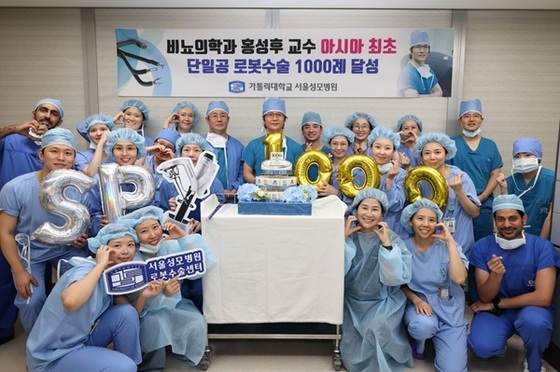
A South Korean physician has become the first in the Asia-Pacific region to personally perform 1,000 single-port (SP) robotic urologic surgeries.
The Catholic University of Korea Seoul St. Mary’s Hospital said July 4 that Professor Hong Seong-ho of the Department of Urology reached the milestone of 1,000 single-port robotic urologic surgeries on July 3.
Physicians who have surpassed 1,000 individual cases using the da Vinci SP robotic system are rare outside the United States, and Seoul St. Mary’s Hospital said the achievement demonstrates the competitiveness of South Korea’s urologic robotic surgery capabilities.
Of Professor Hong’s 1,000 surgeries, 97% involved patients with urologic cancers. By disease, kidney cancer accounted for the largest share at 54%, followed by prostate cancer at 30%, ureteral cancer at 14% and bladder cancer at 2%.
Single-port partial nephrectomy, which removes only the cancerous portion of the kidney to preserve as much kidney function as possible, accounted for 54% of all cases, or 539 surgeries. The 1,000th patient was also a patient in their 60s with kidney cancer who underwent single-port robotic surgery to remove the tumor while preserving as much kidney function as possible.
Professor Hong has also recently published research demonstrating the safety and efficiency of single-port robotic surgery for kidney cancer.
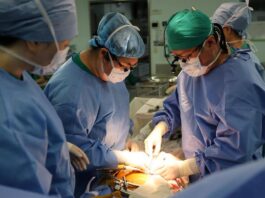
Unlike conventional multi-port robotic surgery, which requires multiple incisions in the abdomen or flank, single-port robotic surgery uses a single incision to insert robotic instruments. While fewer incisions can reduce pain and scarring, the procedure requires advanced surgical expertise because multiple instruments must be manipulated through a single access point.
However, because multiple instruments must be operated simultaneously through a single access point, the procedure is technically demanding, and until recently, it was considered somewhat slower than multi-port robotic surgery.
However, when Professor Hong’s research team compared single-port and multi-port robotic surgery in kidney cancer patients, the average warm ischemia time for single-port robotic surgery was 13.8 minutes, 3.4 minutes, or 19.8%, shorter than the 17.2 minutes recorded for multi-port surgery. Warm ischemia time refers to the period between temporarily stopping blood flow to the kidney and restoring circulation, with a shorter time considered favorable for preserving kidney function after surgery.
The average operating time was also shorter with single-port surgery, at 95.4 minutes compared with 103.7 minutes for multi-port surgery, while blood loss and length of hospital stay showed comparable or better outcomes. The study was published in the international journal Journal of Endourology in December last year and also received an academic award from the Korean Endourological Society.
Professor Hong currently serves as director of the Robotic Surgery Center at Seoul St. Mary’s Hospital. He was the first in South Korea to apply Retzius-sparing prostatectomy to single-port robotic surgery, reducing complications such as urinary incontinence and erectile dysfunction. For kidney cancer, he has also demonstrated the effectiveness of single-port partial nephrectomy using a retroperitoneal approach, which reduces the risk of injury to intra-abdominal organs.
More recently, he treated an elderly kidney cancer patient with a tumor thrombus extending into the inferior vena cava using single-port robotic surgery, marking the first such procedure in South Korea and the second in the world. He also continues to train physicians from overseas and conduct international joint research.
“I believe it is a physician’s duty to give courage and hope to patients who have fallen into despair,” Professor Hong said. “I will continue my research to develop better treatments for malignant diseases, including kidney and prostate cancer, and bring them into clinical practice.”