The competitive focus of the medical artificial intelligence (AI) industry is shifting from “technology development” to “real-world adoption in clinical settings.” While the number of products receiving innovative medical technology designations and regulatory approval from the Ministry of Food and Drug Safety continues to grow, industry recognition is expanding that health insurance reimbursement is essential for widespread use in medical institutions.
Going forward, companies’ success is expected to depend less on how advanced their algorithms are and more on how much clinical evidence they can accumulate and whether they can enter the national reimbursement system.
According to industry sources on Aug. 10, the Ministry of Health and Welfare and the Korea Health Industry Development Institute recently launched a medical AI demonstration support program involving six medical AI company consortiums. Major medical AI companies, including Mediwhale, JLK and Lunit, are participating in the program to apply their products in real clinical environments and verify clinical effectiveness and health economic value.
Most medical AI solutions are currently used on a non-reimbursed basis, placing a significant financial burden on patients and limiting adoption by medical institutions. Demonstrating clinical utility and cost-effectiveness in real-world settings is considered a prerequisite for future reimbursement discussions.
Against this backdrop, the demonstration support program is viewed as meaningful not only for validating technologies but also for generating key evidence needed for future inclusion in the national health insurance reimbursement system. The Ministry of Health and Welfare is also shifting its policy focus for the medical AI industry from “technology development” to “clinical adoption.”
“The most urgent request from companies was the opportunity to validate their technologies in actual medical settings and accumulate data,” Kim Yu-ra, director of the Medical Device and Cosmetics Policy Division at the Ministry of Health and Welfare, said. “The government will provide institutional support so companies can freely conduct real-world demonstrations and build evidence.”
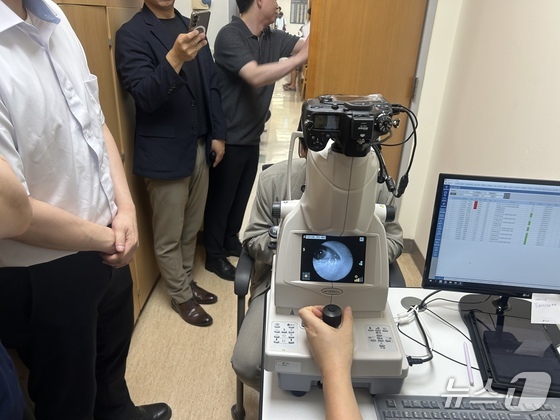
Industry participants also identify reimbursement access as a bigger challenge than regulatory barriers. Mediwhale is participating in the program with its AI solution “Dr. Noons CVD,” which predicts cardiovascular disease risk using only retinal imaging.
Having secured clinical data showing that the technology can identify patients at high risk of metabolic syndrome or cardiovascular disease at an early stage, the company aims to prove its value in real clinical environments and eventually pursue reimbursement coverage. The service is currently expanding mainly through health screening centers, with plans to extend applications to chronic disease management and national health screening programs.
“Reimbursement system entry is necessary for more people to benefit from medical AI,” Mediwhale CEO Choi Tae-geun said. “This demonstration project is also a process of proving health economic value and connecting technology to actual patient benefits.”
The demonstration project goes beyond simply evaluating whether AI can accurately predict disease. It will track differences in cardiovascular disease outcomes and treatment intervention effects between AI-assisted and non-AI groups over an extended period to accumulate sufficient clinical evidence.
Lunit is also expanding domestic and international clinical evidence for its chest imaging and breast cancer diagnostic AI solutions to improve the possibility of insurance coverage. JLK is similarly focusing on expanding hospital adoption of its stroke AI solutions while building evidence needed for broader reimbursement.
Some industry observers say the medical AI market has entered a new phase beyond regulatory approval competition, moving toward integration into actual health care systems. In the past, regulatory approval and innovative medical technology designation served as key indicators of competitiveness, but going forward, insurance coverage and hospital adoption rates are likely to determine market success.
“Regulatory approval is only the starting point for market entry,” an industry official said. “The industry can grow and patients can experience the benefits of AI-based medical services only when these technologies are consistently used in hospitals and connected to reimbursement.”