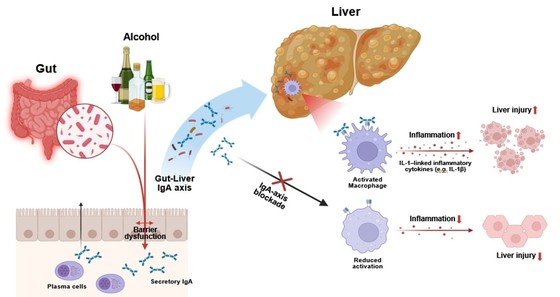
New research suggests that immunoglobulin A (IgA), traditionally known as the intestinal guardian antibody, may play a pivotal role in triggering liver inflammation and damage in alcohol-related liver disease.
A team of researchers from the Catholic University of Korea’s Seoul St. Mary’s Hospital, led by co-first authors Dr. Tak Kwon-yong and graduate student Kim Min-gu, has uncovered a gut-liver IgA axis. This mechanism involves increased IgA levels in alcohol-related liver disease traveling to the liver, interacting with immune cells such as macrophages, and ultimately leading to severe inflammatory responses and liver cell damage.
IgA is a primary defense antibody that guards against bacterial and viral invasions at mucosal surfaces, including those in the intestines and respiratory tract. It’s particularly crucial in mucosal immunity, preventing gut microbes from breaching the body’s defenses.
However, patients with alcohol-related liver disease often show elevated blood IgA levels. Until now, it wasn’t clear whether this increase was a consequence of the disease or a contributing factor to liver inflammation and damage.
To investigate this, the research team employed a multifaceted approach, combining patient blood and liver tissue analysis with animal models, spatial transcriptomics, and human immune cell experiments to trace IgA’s role. They focused particularly on monocytes and macrophages, which aid in removing foreign substances and tissue recovery but can trigger inflammation if overactivated.
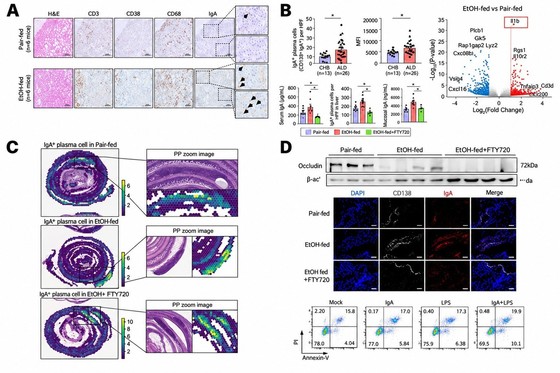
The analysis revealed a correlation between higher blood IgA levels and increased IgA accumulation in liver tissue, with IgA binding to liver monocytes and macrophages. This phenomenon was also linked to elevated levels of the inflammatory cytokine interleukin-1 beta (IL-1β).
Based on these findings, the research team proposed that IgA isn’t merely an elevated lab value resulting from the disease but may directly participate in the inflammatory response of liver immune cells.
In alcohol-treated animal models, researchers observed increased blood IgA, IgA binding to liver macrophages, elevated IL-1β expression, and liver damage. Interestingly, administering FTY720, a drug that regulates immune cell migration, reduced blood IgA levels and IgA-bound liver macrophages, alleviating inflammation and liver damage.
The team emphasized that this study is significant because it offers a novel perspective on the gut-liver axis. Unlike previous research that focused on gut microbes or bacterial-derived substances, this study demonstrates that antibodies produced in the gut can directly regulate liver inflammation.
Co-first author Dr. Tak highlighted the study’s importance, stating that its research demonstrates a clear link between increased gut IgA and its migration to the liver, where it amplifies immune cell inflammation and contributes to liver cell damage. If it can confirm how accurately blood IgA reflects liver inflammation, it could become a valuable clinical biomarker.
Corresponding author Professor Seong noted that alcohol-related liver disease is a major global health concern, yet effective treatments remain limited. This study is groundbreaking as it expands the understanding of the gut-liver connection beyond gut microbes to include the body’s immune system via IgA.
He added that since IgA is essential for our body’s defense, completely suppressing it can’t be the goal. The key is to develop targeted therapies that selectively regulate the pathological gut-liver IgA immune axis while preserving normal immune function.

This groundbreaking research was recently published in Gut, a prestigious international journal focusing on gastrointestinal and liver diseases, with an impact factor of 24.6.