Wearable robotics company Angel Robotics has unveiled phai-x1, a wearable robot platform designed specifically for physical AI research and development.
Physical AI refers to technologies that allow AI systems to perceive their physical surroundings and perform actions through devices such as robots.
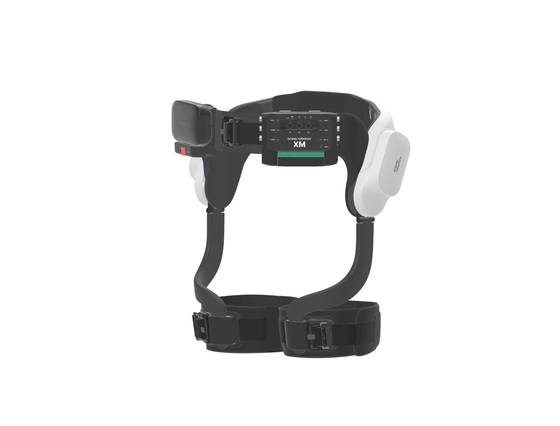
Built on Angel Robotics’ ANGEL SUIT H10 walking-assistance robot, phai-x1 is designed to let researchers develop and directly test their own control algorithms.
The system independently controls the left and right hip joints, while the XM10 expansion module allows researchers to configure their own programs. It can execute control algorithms at up to 1,000 times per second (1 kHz), enabling researchers to test and validate performance directly on the robot.
phai-x1 can also convert human movement into data for AI training. Researchers can connect sensors including inertial measurement units (IMUs), electromyography (EMG) sensors that measure muscle activity, and ground reaction force (GRF) sensors that measure forces generated when the foot contacts the ground.
These capabilities can be used to study human walking and human-robot interaction, develop systems that predict user movements and provide assistance accordingly, and research AI reinforcement-learning-based control systems.
Angel Robotics has traditionally focused on wearable robots for rehabilitation and walking assistance. Its major product lines include ANGEL LEGS, which is used for gait rehabilitation training in hospitals, and ANGEL SUIT, which assists users with walking in everyday environments.
phai-x1 takes the company’s technology beyond finished walking-assistance products by turning its accumulated robotics hardware and control technology into a research platform that can be used by external researchers.
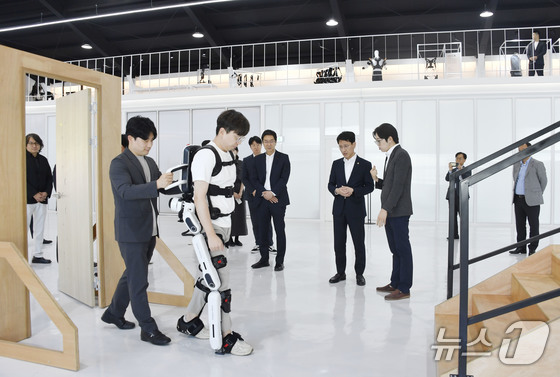
At the IFAC Wearable Robot Challenge 2026 held in August, participants received about two hours of training before using phai-x1 to develop their own algorithms. Over two days, participants implemented systems for slip detection and assistance control, gait support for people with hemiplegia, and EMG-based performance evaluation.
Angel Robotics plans to expand phai-x1 distribution to universities, public research institutions, corporate research centers, university hospitals and medical schools, as well as biomedical engineering and rehabilitation engineering research organizations.
“To enable AI to truly understand human movement, camera footage alone is not enough,” said Kong Kyung-chul, director of Angel Robotics’ Future Technology Institute. “We hope phai-x1 can serve as a common research platform for researchers across different fields and contribute to the growth of Korea’s physical AI research ecosystem and industry.”