Hallym University Gangnam Sacred Heart Hospital has opened the world’s first training center dedicated to robot-assisted endoscopic spinal surgery and signed an agreement with Sijibio to promote the technology and provide training for physicians from Korea and overseas.
The Hallym Robot Endoscopic Spine Surgery Training Center officially opened on Sept. 18, with the hospital announcing the initiative on Sept. 29.
The center combines the hospital’s 10 years of clinical and research experience in bilateral spinal endoscopic surgery with robotic and navigation technologies. The goal is to standardize surgical techniques and strengthen physician training.
Training will be conducted in stages and will include lectures, hands-on practice using surgical phantoms and observation of actual procedures. The programs are designed for physicians who perform spinal surgery in clinical practice.
The hospital plans to expand training beyond Korean residents, fellows and spine specialists to physicians from overseas and eventually develop the center into a global training program.
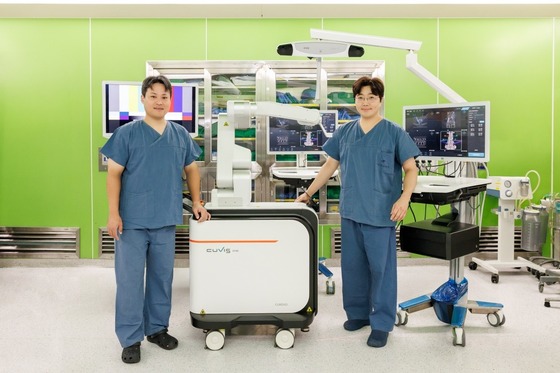
Before opening the center, the hospital introduced the endoscopic spine surgery robot CUVIS-spine.
Bilateral spinal endoscopic surgery is a minimally invasive procedure that uses two small incisions to insert an endoscope and surgical instruments to treat spinal lesions.
Combining the procedure with robotic and navigation technology allows surgeons to plan the position and insertion path of spinal screws based on the patient’s imaging data and verify those plans during surgery.
The hospital expects the technology to preserve the advantages of minimally invasive surgery while improving the accuracy of instrument positioning and reducing the use of intraoperative C-arm fluoroscopy.
Park Hyun-jin, a professor at Hallym University Gangnam Sacred Heart Hospital’s Spine Center, has been developing techniques and conducting clinical research on bilateral spinal endoscopic surgery since 2016.
During training at the Icahn School of Medicine at Mount Sinai in New York, Park also conducted research on integrating stereotactic navigation with bilateral spinal endoscopic surgery. The research was published last year in the international journal JBJS Essential Surgical Techniques.
Park said the hospital has spent the past decade expanding the applications of bilateral spinal endoscopic surgery while researching ways to improve surgical accuracy and safety.
He said the hospital will now extend that experience to robotic and navigation technology, accumulate clinical data, standardize surgical techniques and establish an education system for sharing its experience with physicians in Korea and abroad.
Hallym University Gangnam Sacred Heart Hospital, a university-affiliated hospital established in 1980, currently operates approximately 650 beds, 30 clinical departments and 10 specialized centers.
The hospital also operates a Robotic Surgery Center and a Bilateral Spine Endoscopy Surgery Center as it continues to expand clinical care, research and education in robotic surgery and minimally invasive spinal treatment.