

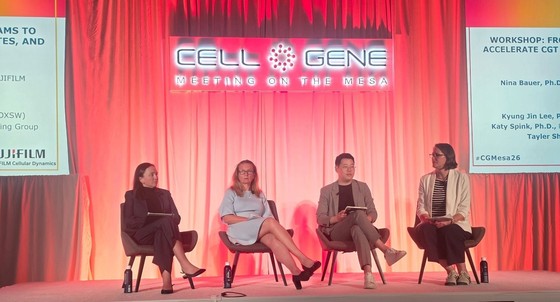
Organoid Science recently showcased its cutting-edge alternative testing methods (NAMs) and breakthroughs in regenerative medicine at a global cell and gene therapy (CGT) event in the U.S.
The biotech firm participated in the Cell & Gene Meeting on the Mesa 2026 in Phoenix, Arizona, on October 5-6, delivering presentations on both days.
On day one, Chief Technology Officer (CTO) Lee Kyung-jin joined representatives from Eli Lilly and Fujifilm to discuss CGT development strategies using NAMs. These innovative methods employ organoids, human-derived cells, and organ-on-chip technologies to assess drug efficacy and safety.
NAMs not only reduce animal testing but also offer a more direct way to study human responses, potentially lowering the risk of early-stage development failures.
With growing concerns about the limitations of traditional animal models in predicting human treatment responses, human-derived organoids are gaining traction in CGT research.
The second day featured Organoid Science’s U.S. subsidiary, Organoid by Southwest, which presented clinical results for its intestinal organoid regenerative medicine ATORM-C and outlined development plans for the salivary gland organoid therapy ATORM-S during an innovation session.
This presentation highlighted the company’s dual strategy of using organoids both as evaluation models in drug development and as therapeutic agents themselves.
Organoid Science aims to create synergies between its NAMs business and regenerative medicine development. The company plans to leverage clinical data from therapy development to enhance NAMs, while using refined organoid models to improve drug development processes.
Since its founding in 2018, Organoid Science has been at the forefront of organoid-based regenerative therapies and drug evaluation platforms. The company secured 8 billion KRW (about 5.9 million USD) in Series A funding in 2020 and was chosen to operate the Cell Therapy GMP at Asan Medical Center. In 2021, it raised 40 billion KRW (about 29.8 million USD) in Series B funding and established the Gwangmyeong GMP Center.
In 2022, Organoid Science launched its organoid-based material evaluation platform ODISEI and expanded its global footprint to the U.S. and Germany in 2023. After clearing the KOSDAQ listing preliminary review in 2024, the company went public in 2025. This year, Organoid Science received approval for a domestic Phase 1 clinical trial of ATORM-C, its intestinal organoid regenerative medicine, marking a significant milestone in its organoid-based therapeutic development.