

Daewoong Bio is expanding its diagnostic business to detect early signs of Alzheimer’s disease through blood tests. The company aims to increase the use of a technology that allows for easier identification of Alzheimer’s-related changes compared to traditional brain imaging or cerebrospinal fluid tests in domestic medical settings.
On Monday, Daewoong Bio announced its collaboration with Lab Genomics to expand the domestic market for Lumipulse, a U.S. Food and Drug Administration (FDA)-approved Alzheimer’s blood diagnostic test.
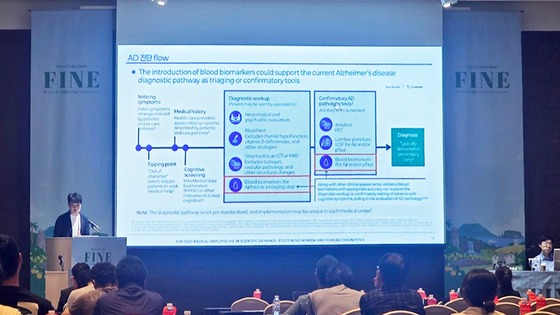
Last month, on September 5-6, Daewoong Bio hosted the FINE Symposium for dementia specialists, showcasing Lumipulse’s technical features and potential clinical applications.
Lumipulse measures two Alzheimer’s-related proteins in the blood: pTau217 and Amyloid Beta (Aβ1-42). By analyzing the ratio of these proteins, the test assesses the likelihood of Alzheimer’s-related changes in the brain.
Alzheimer’s disease is a degenerative brain disorder characterized by the accumulation of abnormal proteins like amyloid beta and tau, which damage nerve cells. As memory and cognitive function progressively decline, early detection and timely treatment are crucial.
Previously, positron emission tomography (PET) scans or cerebrospinal fluid tests were used to detect Alzheimer’s-related protein accumulation. However, PET scans are costly, and spinal taps for cerebrospinal fluid can be uncomfortable for patients.
Recent advancements in blood-based biomarker analysis for Alzheimer’s detection have sparked interest in simpler testing methods. These blood tests can help identify patients who may require more comprehensive examinations.
Lumipulse received FDA approval last year. The company reports impressive clinical trial results, with a positive predictive value of 91.8% and a negative predictive value of 97.3%, indicating high accuracy in aligning test results with actual diagnoses.
At the symposium, Dr. Yang Young-soon from Soonchunhyang University Cheonan Hospital’s neurology department noted that while brain imaging tests previously focused on detecting atrophy, there’s now a growing emphasis on biomarkers that can directly identify Alzheimer’s-related pathological changes.
Dr. Yang added that blood test results can be influenced by comorbidities like chronic kidney disease. Measuring multiple indicators and analyzing their ratios can help offset the limitations of individual markers.
Daewoong Bio plans to leverage Lab Genomics’ diagnostic infrastructure alongside its own sales and marketing expertise to expand the domestic Alzheimer’s blood test market.
Yoo Young-ki, head of Daewoong Bio’s marketing division, stated that by combining our specialized sales and marketing capabilities in neurology with Lab Genomics’ diagnostic technology, it aims to lead the growth and establishment of the blood-based Alzheimer’s diagnostic market.