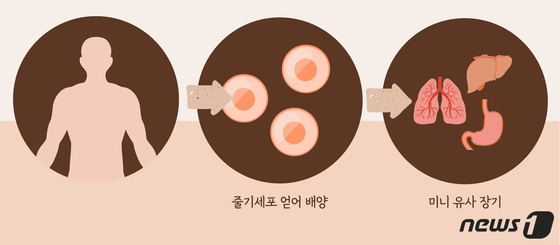
Organoids are evolving beyond simply creating miniature organs that mimic actual organs.
Recent research has not only replicated structures similar to human skin but has also integrated blood vessels and immune functions. These advanced models can now trigger inflammatory responses similar to real diseases and assess reactions to treatments. A prime example is the vascularized skin assembloid developed by Kang Stem Biotech.
On Monday, industry reports revealed that Kang Stem Biotech recently published findings on their skin organoid platform with vascular and immune functions in the international journal Experimental & Molecular Medicine (EMM). EMM is a prestigious life sciences journal provided online by Nature.
From Skin Shape to Skin Function: Adding Blood Vessels and Immune Responses
Organoids are laboratory-grown tissues that mimic the structure and function of actual human organs using stem cells and other advanced techniques. In drug development, these models show promise for verifying the effects and mechanisms of candidate substances before human clinical trials.
However, existing skin organoids have struggled to adequately replicate the crucial blood vessel and immune functions found in real skin.
To overcome this limitation, Kangstem’s researchers combined skin organoids with vascular organoids and incorporated immune cells. The result was a sophisticated skin model featuring not only the epidermis and dermis but also follicular and nerve-related structures, as well as a complex vascular network.
The breakthrough here isn’t just about how closely the model resembles human skin. By incorporating blood vessels and immune cells, researchers can now observe inflammatory responses in the skin with unprecedented realism.
This groundbreaking study, led by Professor Kang Kyung-sun from Seoul National University and Chief Scientific Officer at Kang Stem Biotech, focused on using the vascularized skin assembloid to replicate actual skin diseases and treatment responses.

Creating Atopic Dermatitis: Inflammation Decreases After Treatment
The research team induced an inflammatory response similar to atopic dermatitis by exposing the skin model to dust mite extracts.
This resulted in a decrease of filaggrin, a key protein in the skin barrier, along with increased immune cell infiltration. Inflammatory factors associated with atopic dermatitis, including IL-4, IL-13, TSLP, CCL17, and CCL26, also showed significant increases.
In essence, they didn’t just create skin-like tissue; they replicated the entire process of skin barrier weakening and inflammation in response to allergens, all within a laboratory setting.
The team also tested treatment responses. When they administered upadacitinib and dupilumab, medications used to treat atopic dermatitis, they observed improvements in skin barrier indicators and reductions in inflammatory responses. Both drugs demonstrated reactions consistent with their known mechanisms of action, including a reduction in inflammation signals centered around STAT6.
This breakthrough demonstrates that organoids can serve as sophisticated testing models, not only mimicking specific diseases but also revealing how these conditions respond to various treatments.
A Potential Midway Testing Ground for Drug Development: Challenges Ahead
The implications of such models for skin disease drug development are profound. Skin is a complex organ where immune responses, barriers, and blood vessels interact intricately. Simple cell experiments often fall short in predicting how drugs will behave in human subjects.
As human skin organoids with vascular and immune functions continue to advance, they could become invaluable platforms for evaluating the efficacy and mechanisms of drug candidates before clinical trials. This technology could revolutionize research into various inflammatory skin conditions, from atopic dermatitis to psoriasis, and streamline the selection of promising drug candidates.
However, it’s important to note that organoids won’t immediately replace animal testing or clinical trials. Significant challenges remain, including replicating the diverse skin characteristics of individuals, ensuring consistent experimental results, and maintaining quality during large-scale production.
A spokesperson from Kang Stem Biotech emphasized the significance of confirming responses to actual diseases and treatments by combining vascular and immune functions. They expressed their commitment to developing this technology into a versatile platform for various skin disease research and drug development processes.