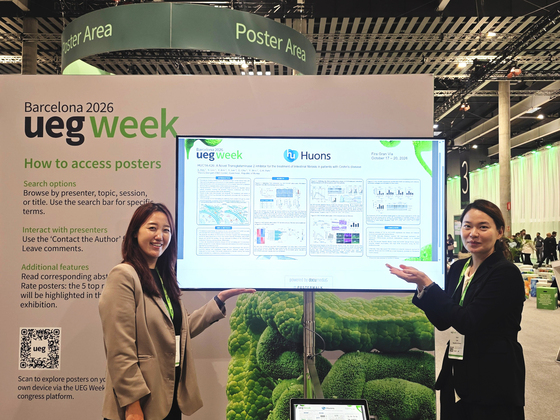
Huons announced on Tuesday that it presented the results of its preclinical study on the selective TG2 inhibitor HUC1A-626 at the United European Gastroenterology Week UEG Week 2026 held in Barcelona, Spain, from October 17-20.
HUC1A-626 is a candidate drug that Huons is developing to treat fibrotic stricturing Crohn’s disease (FSCD).
Crohn’s disease is a type of inflammatory bowel disease that can cause chronic inflammation anywhere in the digestive tract, from the mouth to the anus. Typical symptoms include abdominal pain, diarrhea, and weight loss, with patients often experiencing cycles of symptom improvement followed by flare-ups.
Intestinal fibrosis, characterized by the thickening and hardening of intestinal walls, is a major complication affecting approximately half of Crohn’s disease patients. As inflammation recurs, activated intestinal fibroblasts excessively accumulate extracellular matrix (ECM), which acts as a cellular scaffold, leading to strictures that narrow the intestinal passage. This form of Crohn’s disease is known as fibrotic stricturing Crohn’s disease.
While current biologic agents effectively manage inflammation, they have limitations in suppressing or reversing established fibrotic lesions. Notably, when fibrosis hardens the tissue, fibroblasts detect this change and continue to secrete fibrotic factors, creating a vicious cycle that exacerbates symptoms.
TG2 is an enzyme that cross-links extracellular matrix proteins and inhibits their breakdown, contributing to tissue hardening. Huons has developed HUC1A-626, an oral TG2 inhibitor designed for localized action in the intestines, and has validated its anti-fibrotic effects in cell and animal models.
The study results demonstrated that HUC1A-626 exhibits high inhibitory efficacy and selectivity against TG2. Experiments with human colon-derived fibroblasts confirmed anti-fibrotic effects across multiple pathways. Animal models also showed anti-fibrotic effects, including reduced fibrotic lesions and insoluble collagen content.
Huons plans to develop a differentiated treatment strategy based on these preclinical study results. However, the drug’s therapeutic effects and safety in human patients will need to be confirmed through future clinical trials.
Dr. Park Kyung-mi, Vice President of Research and Development at Huons, stated that this research confirms that the TG2 inhibitor can simultaneously control the cross-linking of extracellular matrix, which is key to intestinal fibrosis, and the activation of fibroblasts. It aims to develop it as the first innovative drug in its class that breaks the cycle of persistent fibrosis, even after inflammation subsides.