Rosota, a surgical AI robotics company that uses procedure data to develop its technology, has released results from a preclinical study in which AI trained on surgeons’ laparoscopic surgery experience performed actual robotic movements. In the study, medical professionals designated the surgical steps, and the AI carried out the instrument movements required for each step. The evaluation included procedures in animals and postoperative survival monitoring.
Rosota announced on the 20th that it used 849 laparoscopic surgery demonstrations involving chinchilla rabbits to train its AI, then evaluated the system’s real-world robotic execution on separate animals that had not been used for training.
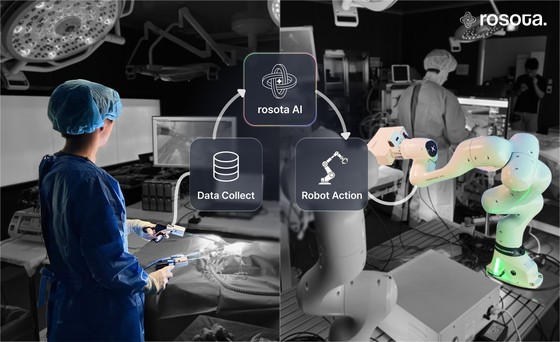
A key feature of the study was that it recorded not only surgical video but also instrument movements, instrument status and sensor data, allowing the AI to learn how surgeons manipulate surgical instruments. Rosota attached proprietary sensors to existing laparoscopic instruments and recorded video and instrument manipulation data on a synchronized timeline. This enabled the AI to learn the relationship between what appeared in the surgical scene and the instruments’ actual movements.
After validation in simulation, the trained AI was evaluated in real robotic executions. The assessment focused on tasks required for appendectomy, including locating the target area, aligning instruments, grasping and retracting tissue, identifying the intended resection site and performing the resection. Rosota said the AI carried out the required instrument movements according to surgical steps specified by researchers. The team also monitored the experimental animals’ recovery and checked for complications after surgery.
However, the study does not demonstrate fully autonomous surgery in which AI independently determines and performs every step of an operation. Instead, medical professionals designate each surgical step, and the AI performs the instrument movements required for that step. Rosota said the significance of the findings lies in demonstrating that surgeons’ experience can be recorded as data, used to train AI and translated into movements performed by a real robot.
Building on the study, Rosota plans to further develop AI surgical copilots and AI robotics technologies that support medical professionals’ decision-making and instrument manipulation. The company aims to expand its data collection across more medical institutions and laparoscopic procedures, continuously train AI on surgeons’ experience and apply the resulting capabilities to clinical decision-making and robotic execution.
“Video alone makes it difficult to fully capture how surgeons actually move instruments and approach tissue,” said Rosota CEO Seo Ye-chan. “We are turning experience accumulated in the operating room into data that AI can learn from and developing the technology into a practical tool that supports medical professionals’ decisions and instrument manipulation.”
Rosota is a surgical AI robotics company that develops AI and robotic technologies using data generated in actual surgical settings. It collects and structures multimodal data, including surgical video, instrument movements, force and torque measurements, and processes the data into formats that AI systems and robots can learn from to support the development of surgical AI and robotics technologies.