Soonchunhyang University Bucheon Hospital announced on the 27th that Professor Jung Soo-ho of its Department of Obstetrics and Gynecology had performed robot-assisted myomectomies on three women in their 30s and 40s with large, multiple uterine fibroids who were planning pregnancies, removing the fibroids while preserving their uteruses.
Uterine fibroids are benign tumors that develop in the muscular wall of the uterus. They can cause heavy menstrual bleeding, painful periods and pelvic pain, or put pressure on nearby organs. Surgery becomes more challenging when fibroids are large or multiple, depending on their size, number and location.
Fibroids can also affect pregnancy depending on their size and location. Those that distort the uterine cavity may interfere with embryo implantation and the ability to maintain a pregnancy. Treatment plans therefore need to account for the patient’s pregnancy plans, the location of the fibroids and any symptoms.
For patients planning to become pregnant, removing fibroids is only part of the goal. Precisely reconstructing the uterine muscle and preserving the uterus are also essential.
According to the hospital, the first patient, a woman in her 40s identified as A, sought treatment for lower abdominal pain, severe menstrual cramps and a palpable abdominal mass. Ultrasound and magnetic resonance imaging (MRI) revealed multiple uterine fibroids, including one measuring approximately 11 centimeters. The fibroids were distributed throughout the uterine muscle and were compressing the uterine cavity.
Professor Jung used robot-assisted myomectomy to remove approximately 10 fibroids. The removed tissue weighed about 720 grams, and blood loss during surgery was approximately 200 milliliters.
Another patient, a woman in her 40s identified as B, underwent testing for persistent anemia and learned that her uterine fibroids had increased in both size and number. She visited the hospital for surgery. MRI revealed multiple fibroids, including one measuring approximately 11 centimeters. Because she planned to become pregnant, minimizing blood loss while removing the fibroids was particularly important.
Professor Jung removed a total of 400 grams of fibroid tissue using robot-assisted myomectomy, preserving the uterus. Blood loss during surgery was approximately 100 milliliters.
A third patient, a woman in her 30s identified as C, came to the hospital after another medical institution recommended surgery for a large uterine fibroid. MRI revealed more than 10 fibroids, including one measuring up to 9.2 centimeters. The fibroids were located both within the uterine muscle and beneath the uterine lining, with some protruding into the uterine cavity and pressing against the lining.
Professor Jung used robot-assisted myomectomy to remove 10 fibroids. The removed tissue weighed approximately 350 grams, and blood loss during surgery was about 200 milliliters. Patient C is currently recovering from surgery.
Robot-assisted surgery uses magnified three-dimensional images and articulated surgical instruments to enable precise procedures, even in the confined space of the pelvic cavity. However, the appropriate surgical approach must be determined based on factors including the size and location of the fibroids and the patient’s condition.
According to the hospital, patients A and B completed their surgeries in less than two hours without conversion to open surgery. Both were discharged within seven days of surgery without any notable complications.
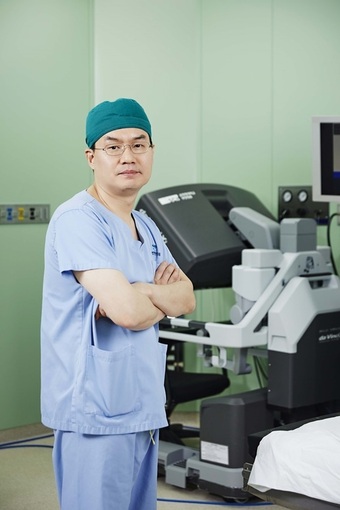
Professor Jung performs approximately 1,000 to 1,500 gynecological surgeries each year. Soonchunhyang University Bucheon Hospital introduced robotic surgery in April 2017, and Jung reached 1,000 procedures using the da Vinci Xi robotic surgical system in 2023. According to the hospital, Jung had performed a cumulative total of 1,727 robotic surgeries as of the 16th, with procedures related to uterine fibroids accounting for approximately 39.14% of the total.
“For patients planning to become pregnant, uterine fibroid surgery requires not only removing the fibroids but also preserving the uterus and thoroughly reconstructing the uterine wall,” Professor Jung said. “These three cases are significant because robot-assisted surgery enabled us to preserve the uterus in patients with large, multiple fibroids without converting to open surgery.”