

Samsung Biologics is bolstering its competitive edge in contract development operations (CDO) by leveraging its tailored process development capabilities to accelerate the timeline for next-generation biopharmaceuticals, including bispecific antibodies. The company recently unveiled a remarkable achievement: slashing the time from cell line development to Investigational New Drug (IND) application submission by about 27%, from 13 months to 9.5 months.
This strategy extends beyond merely scaling up production; it’s aimed at engaging with clients from the earliest stages of drug development and securing business opportunities that span from development through to commercial production.
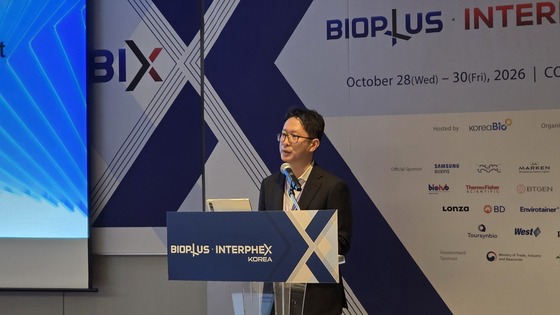
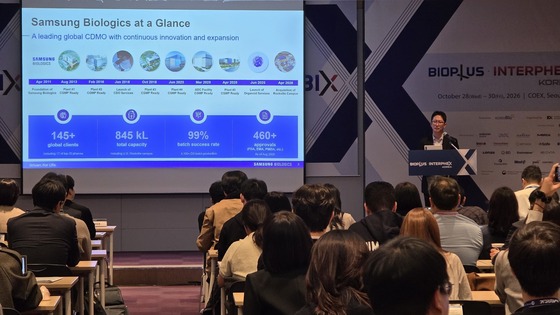
On Wednesday, Samsung Biologics presented its strategies for tackling technical challenges in bispecific and multivalent antibody development at the ‘BioPlus-InterPhex Korea (BIX Korea) 2026’ event in Seoul’s COEX convention center.
Lee Tae-hee, head of the Antibody Cell Purification Process Development Team, outlined approaches for designing processes tailored to material properties at each stage, from cell line development to cultivation, purification, formulation design, and structural analysis.
◇Bispecific Antibodies: Manufacturing as Challenging as Their Therapeutic Promise, with Tailored Processes Key to Competitiveness
Bispecific antibodies are engineered to allow a single molecule to target two different antigens simultaneously. This innovative approach enables novel therapeutic strategies, such as linking cancer cells with immune cells or targeting multiple disease-related antigens at once, setting them apart from traditional monoclonal antibodies.
However, their development is highly complex. Multiple protein chains must bond precisely in the intended configuration, and during production, proteins can fragment or clump together abnormally.
These impurities and structural alterations can impact the final product’s quality, necessitating meticulous management from cell line selection to cultivation and purification conditions. Consequently, it’s crucial to design processes that consider each molecule’s unique characteristics rather than applying standard monoclonal antibody production processes.
Samsung Biologics reported that it’s optimizing processes based on its experience with over six molecular formats, including symmetric and asymmetric bispecific antibodies, fusion proteins, and bispecific antibodies. The company fine-tunes conditions for each stage—cell line development, cultivation, purification, formulation design, and structural analysis—according to the specific material being used.
◇Protein Cleavage Down 34% and Aggregation Down 17%, Shortening Development Timelines
The company’s key achievement lies in minimizing quality issues from the cell line development stage and enhancing subsequent process efficiency. By implementing technology that regulates the expression ratio of protein chains in bispecific antibodies, Samsung Biologics minimizes misassembled materials and selects optimal cell lines by verifying both yield and assembly ratios.
During cultivation, the company optimized media and culture conditions, resulting in a 34% reduction in protein fragmentation and a 17% decrease in aggregation. In the purification stage, they designed processes to eliminate impurities with similar characteristics to the target protein, achieving a final purity exceeding 98%.
Parallel processing strategies and advanced stability verification technologies were employed to reduce inter-process waiting times. By coordinating simultaneous tasks and streamlining process verification, the overall timeline was shortened. These efforts cut the period from cell line development to IND submission from 13 months to 9.5 months, a reduction of approximately 27%.
Shortening development timelines can significantly reduce costs and time pressures for drug developers. Rapid verification of candidate substances’ productivity and quality in early development stages can accelerate clinical entry preparation and provide advantages when considering production scale-up.
Samsung Biologics aims to strengthen its one-stop contract development and manufacturing (CDMO) services, covering everything from early development to commercial production and global regulatory compliance. To this end, the company has participated in BIX Korea for five consecutive years, showcasing its comprehensive capabilities in production, contract research (CRO), and CDO throughout the entire drug development process.