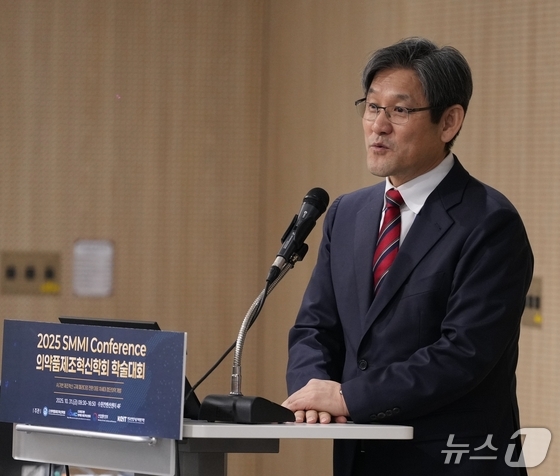
“Discovering new compounds is important, but the ability to consistently manufacture products of the same quality is itself a competitive advantage. Success means going beyond identifying drug candidates to reliably producing medicines and delivering them to patients.”
Young-joon Park, president of the Pharmaceutical Manufacturing Innovation Society and a professor at Ajou University College of Pharmacy, said South Korea’s biopharmaceutical industry will struggle to compete in global markets if it focuses exclusively on discovering drug candidates. He said companies must also accelerate advances in manufacturing technology, noting that AI- and digitally enabled continuous manufacturing could reduce production costs by 30% and defect rates by 5%.
“Drug Manufacturing Is a Matter of National Competitiveness” — Clear Regulatory Standards Needed to Spread New Technologies
In an interview with News1 on the 30th of last month, Park emphasized the importance of CMC, or Chemistry, Manufacturing and Controls. CMC refers to the process of demonstrating that a drug can be manufactured repeatedly with consistent quality.
He also identified relatively low investment in advanced manufacturing technologies as a weakness in South Korea’s pharmaceutical industry compared with investment in drug candidate discovery and advanced biotechnology. “Support should not be concentrated in just one area,” Park said.
“Companies need the manufacturing capabilities to deliver to patients medicines developed across a range of fields, including small-molecule compounds, drug delivery systems, antibodies and proteins,” he said. His point was that drug development and manufacturing infrastructure must be strengthened in a balanced way.
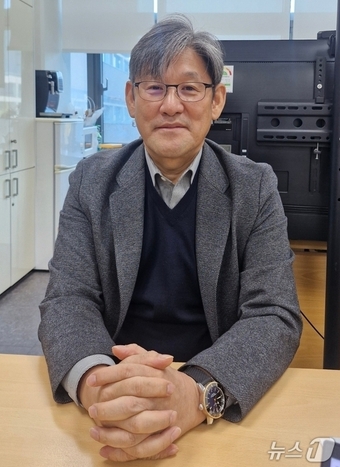
Park highlighted continuous manufacturing as a major change taking place on the factory floor. In conventional drug production, a batch is manufactured and a portion is sampled for quality testing. Continuous manufacturing, by contrast, enables quality to be monitored throughout the production process in real time.
Integrating AI and digital technologies makes it possible to analyze process data, quickly detect abnormalities and prevent defective products from advancing to the next stage. This approach can improve production efficiency while making quality control more precise.
Citing research findings, Park said adopting continuous manufacturing could reduce pharmaceutical production costs by 30% and lower defect rates by 5%. Other advantages include shorter production times, reduced factory space requirements and greater resilience to labor shortages.
However, adoption in South Korea remains at an early stage. In the past, equipment alone for a continuous manufacturing system cost approximately $6.7 million, while the total investment, including facilities and utilities, reached about $13.3 million. With support from a project funded by the Ministry of Trade, Industry and Energy, Park’s research team is developing and validating a prototype designed to bring equipment costs below $1.33 million.
Park also stressed the government’s role. With the current pharmaceutical manufacturing innovation initiative scheduled to end next year, he said a follow-up program should be established and the government should provide initial support to encourage companies to invest in new manufacturing technologies.
In particular, he said the Ministry of Food and Drug Safety should provide specific guidance on the documentation companies must submit when transitioning to continuous manufacturing, reducing regulatory uncertainty. Establishing a regulatory framework that gives companies confidence to adopt new technologies is another key challenge in modernizing production processes, he added.
“Manufacturing innovation should not be treated as something companies are simply expected to handle on their own,” Park said. “Manufacturing itself is a new area of technological innovation. Just as in the semiconductor industry, the ability to reliably produce products with consistent quality can become a source of national competitiveness.”
The Pharmaceutical Manufacturing Innovation Society was founded in 2023 to advance pharmaceutical manufacturing processes and quality control through digital transformation and foster collaboration among industry, academia and regulatory agencies. Park serves as its inaugural president.
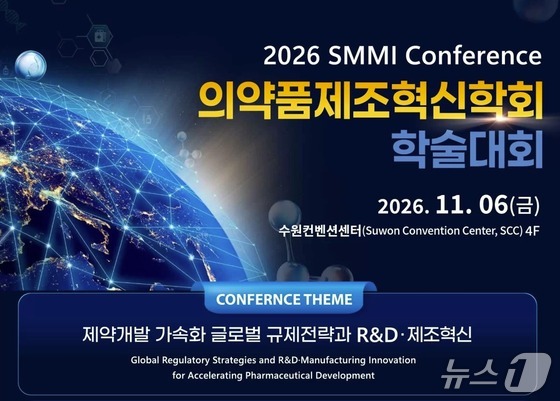
The society will hold its 2026 academic conference on the 6th at the Suwon Convention Center in Gyeonggi Province under the theme “Global Regulatory Strategies for Accelerating Drug Development and Innovation in R&D and Manufacturing.” Key topics will include CMC strategies for navigating the global regulatory landscape and next-generation manufacturing technologies.
“Basic CMC, manufacturing and quality systems are always essential, like air and water, but their importance is not always visible in everyday operations,” Park said. “Policies, regulations and support measures must be developed together to integrate AI and digital technologies into manufacturing sites and expand their adoption across the industry.”